


A few weeks ago, we shared the story of a book that crossed a prison wall.
I sent Theo of Golden by Allen Levi to my friend Teddy, who is incarcerated in California. I listened to the audiobook while Teddy read the print edition – and, along the way, he began reading it aloud to his cellmate.
What began as a gift became a shared reading experience among three people in very different places.
The book’s themes – kindness, regret, grief, redemption, generosity, and the quiet ways one person can change another person’s life – felt especially meaningful in that setting.
After finishing the book, I wrote to its author, Allen Levi.
I wanted him to know where his book had gone.
I told him about Teddy, about Theo of Golden being read aloud inside a prison cell, and about the work of Adopt an Inmate to foster connection and remind people of their inherent dignity.
I did not know whether my message would reach him or whether anyone would have time to respond.
But it did, and they did.
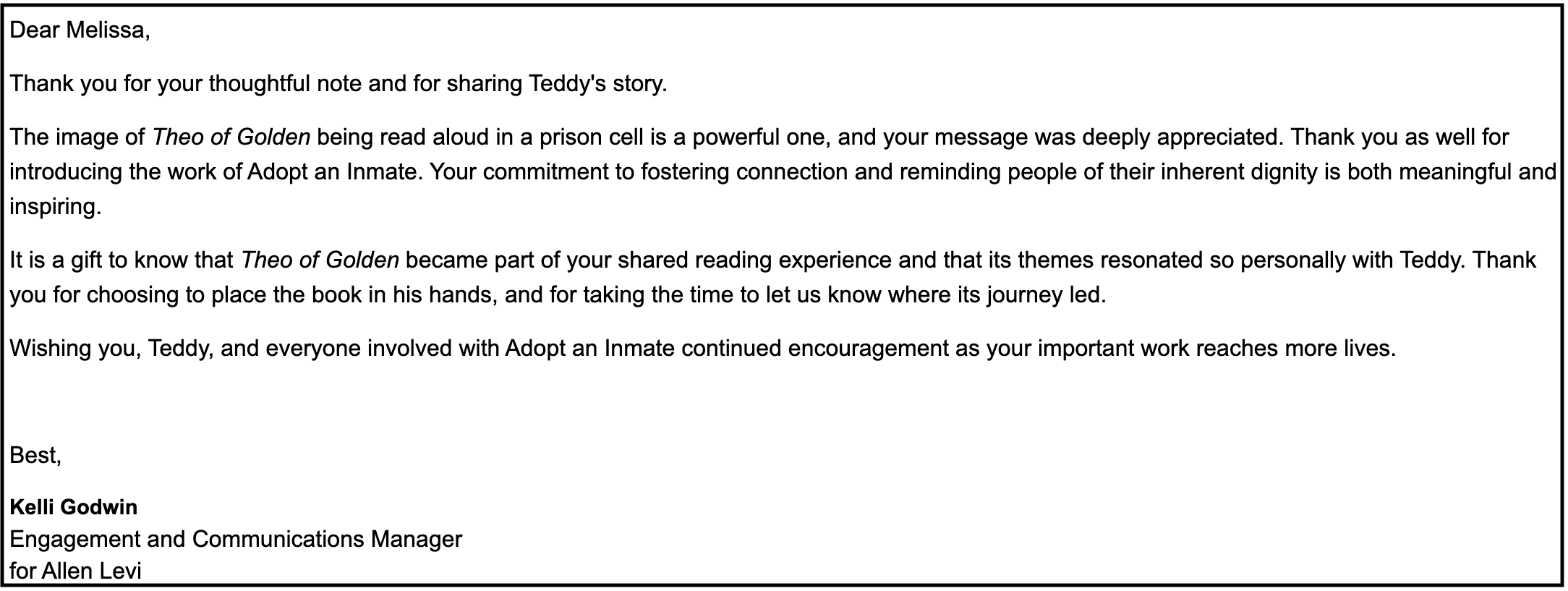
“The image of Theo of Golden being read aloud in a prison cell is a powerful one.”
Yes it is.
The scene that holds the heart of the story
Kelli’s reply also led me back to a short video in which Allen Levi is asked whether he has a favorite moment or chapter in Theo of Golden.
His answer is that he does not, exactly. But he identifies one encounter as especially significant thematically: a legal conversation between Kendrick Whitaker and District Attorney Derrick Prentiss in Chapter 42.
Allen Levi practiced law and also served as a judge, which gives particular weight to his understanding of this moment. He knew the legal system from within – the gravity of its decisions, the pressures placed on the people making them, and the human lives that cannot be contained neatly within a case file.
***Spoiler note: The following discusses an important storyline in the novel***
The encounter Levi refers to is when Mr. Mendez, an undocumented father who had returned to the United States because his own daughter needed cancer treatment, is being sentenced for causing an accident that resulted in terrible loss and injury to Kendrick and his family.
What the District Attorney does not remember is that Kendrick himself has been in his own courtroom before.
Kendrick: I don’t mean to be rude or anything, but you don’t remember me, do ya?
Prentiss: No, sir, Mr. Whitaker, I don’t. Where would I know you from?
Kendrick: From the courthouse, about eighteen months ago. I think maybe you don’t remember me ‘cause you never looked at me. You didn’t look at me a single time. You put me in jail eighteen months ago for something I didden do.”
Prentiss: I handle a whole lot of cases. Sometimes too many and too quickly. I admit, I don’t really have time to look at everybody.
Kendrick: I don’t mean to be disrespectful, Mr. Derrick, and I know you deal with some mighty bad people, but it might do you good to look at some faces sometimes. There are some real people in those faces.
I learned something from Mr. Theo. God gave us faces so we can see each other better.
Kendrick looks into Mr. Mendez’s face and recognizes fear, grief, love, and a father’s desperation. Mr. Mendez is no longer only the man responsible for the worst day of Kendrick’s life. He becomes a person.
Theo does not ignore people’s flaws or losses.
He looks deeply enough to see beyond them.
Theo shows people something they may no longer be able to see in themselves. He recognizes their goodness, their sorrow, their beauty, their contradictions – even their sainthood – not because they are flawless, but because their flaws and losses are not the whole of who they are.
The scene does not deny the terrible harm Mr. Mendez caused. Kendrick’s family is still suffering. Nothing restores what was lost.
But Kendrick comes to understand that recognizing another person’s humanity does not betray the people we love, or erase accountability.
Mercy is not blindness.
People in prison are constantly reduced to abstractions: an offense, a sentence, a number, a label, a single terrible chapter.
Our work asks people to look further.
To see a face. To read a story. To discover qualities that may not appear anywhere in a court record or case file.
To recognize a full human life.
Read our original post:
Shared Reading with Adopt an Inmate
Watch Allen Levi discuss the scene in Chapter 42:
Learn more about Allen Levi and Theo of Golden
Purchase Theo of Golden from your favorite bookseller:
Bookshop.org
AbeBooks
Thrift Books
Amazon
Barnes and Noble
Simon and Schuster


0 Comments