Welcome to Bee Sides short reflections on justice, hope, and the human spirit
This series is a corner of our blog where I gather books, stories, and unexpected moments that linger long after the first glance.
Most will tie back to incarceration, justice, and the quiet fight for dignity. But sometimes? It’ll simply be whatever refuses to let go — the echoes that stay with me. Because that’s what Bee-Sides are for.
Let me know what you’re reading, watching, or wondering about. Maybe it’ll make the next issue.
This one’s about what we carry after unimaginable injustice.
In the span of 24 hours, I saw that unfold in very different ways.
A man I admired, who once wore prison blues, now belittles those still trapped in the system he escaped. I won’t share the specifics of the conversation, only that something in me cracked.
Then came Jeff.
Inside and serving life, he responded without pause when I made an urgent request. I needed help identifying men inside for a developing restorative justice program that Jeff himself isn’t eligible for. The deadline was the following day and I had few candidates.
Credit: Lifegate.com #Kintsugi: The art of precious scars
Within hours, I had names, context, and backstory – everything I needed. If you know, you know: that’s no small feat from behind concrete, metal, and barbed wire.
Jeff’s response didn’t undo the crack. But he unknowingly honored it, turning it into something I could carry.
In Japanese culture, there’s a practice called kintsugi, repairing broken pottery with gold, not to hide the fracture, but to mark it as part of the object’s history. A sign of survival.
That’s what Jeff gave me.
Note: Jeff, the lifer whose kindness sparked this post, is on our waiting list, hoping for someone to connect with. If you feel called to reach out, you can comment below, contact us, or submit an adopter form. (Check out our FAQ about adopting).
🐝 One connection can change everything.
That contrast brought Ray Hinton to mind, a man who lost three decades to injustice, and yet refuses to let it steal his joy. Asked if he was angry (~11:00 in, in the video below), he said:
Scott Pelley: Are you angry?
Ray Hinton: No.
Scott Pelley: How could you not be? Three decades of your life, most all of your life.
Ray Hinton: They took 30 years of my life, as you said. What joy I have I cannot … afford to give that to ’em. And so being angry is … would be giving them … letting them win.
Scott Pelley: You’d still be in prison.
Ray Hinton: Oh absolutely. I am a person that love to laugh. I love to see other people smile. And how can I smile when I’m full of hate. And so the 30 years that they got from me, I count today … I count every day as a joy.
There it is. The difference between survival and true freedom.
What gets carried through the gate?
If you want to hear Ray Hinton’s story in his own words, see the 60-minutes episode featuring Hinton and his longtime advocate, Bryan Stevenson of the Equal Justice Initiative.
You can dive deeper with these powerful books:
The Sun Does Shine by Anthony Ray Hinton Genre: Memoir / Wrongful Conviction Ray Hinton spent 30 years on Alabama’s death row for a crime he didn’t commit. His story isn’t just about injustice, it’s about grace. I still think about his sense of humor, his unshakable belief in hope, and the deep friendships he formed inside. It’s the kind of book that wrecks you and rebuilds you.
Buy on Barnes & Noble (Note: Barnes & Noble is the only vendor allowed to ship into Arizona prisons)
Just Mercy by Bryan Stevenson Genre: Memoir / Criminal Justice Reform Bryan Stevenson’s work through the Equal Justice Initiative has saved countless lives and exposed the brutal realities of mass incarceration, racial injustice, and wrongful conviction.Just Mercy isn’t just a book about the broken system — it’s a call to empathy, action, and courage. Stevenson reminds us that “each of us is more than the worst thing we’ve ever done.” His compassion, perseverance, and relentless belief in human dignity stay with you long after the last page.
As we welcome the warmth and renewal of spring, now’s a great time to check in with your adoptee (or any loved one inside). A letter, card, or even a quick note can make a world of difference.
Here are a few conversation starters and observances to inspire your May correspondence:
May is:
Mental Health Awareness Month
National Reentry Month
National Foster Care Month
National Letter Writing Month (technically April, but we say keep it going!)
Notable Dates in May:
May 1: May Day / International Workers’ Day
May 4: Star Wars Day (“May the 4th be with you”)
May 5: Cinco de Mayo
May 8: National Teacher Appreciation Day
May 12: Mother’s Day
May 15: International Day of Families
May 18: Armed Forces Day
May 25: National Missing Children’s Day
May 27: Memorial Day
Writing Tip: Not every message has to be long or profound. Even a simple “thinking of you” or funny quote goes a long way.
Make sure books are shipped directly from the bookseller (Amazon is usually accepted; Arizona only allows Barnes & Noble). Contact us if you’re unsure what’s allowed.
Thank you for showing up with consistency and care. Your presence matters more than you know.
🔍 Claim: “Prisoners are just living off taxpayers—they don’t need support.”
🔍 Fact check: FALSE.
📣 TRUTH: Many people in prison work full-time jobs — for pennies, or nothing, per hour. Most are also parents, caregivers, and future community members.
People in prison often rely on outside support for basics like soap, stamps, and food from commissary.
.💡 Reminder: Dignity shouldn’t disappear at the prison gate. We all benefit when we support rehabilitation and connection.
Welcome to Policy vs. People, a series that cuts through the fog of political soundbites to ask one critical question: Who is this policy hurting?
Every law, budget cut, and bureaucratic barrier has a human cost. And too often, the people impacted—especially those behind bars or living on the margins — are left out of the conversation.
In this series, we break down policies that affect incarcerated people and their loved ones. We look at what’s really being funded (or defunded), whose voices are being silenced, and how we can shift the narrative.
From overpriced prison phone calls to the quiet gutting funding for public defenders, we’re here to expose the policies that punish and profit at the expense of humanity.
Because when policy ignores people, we all pay the price.
If you’ve ever received a handwritten letter from someone in prison, you already know how powerful it can be.
For people inside, mail isn’t just a lifeline — it’s evidence that someone cares.
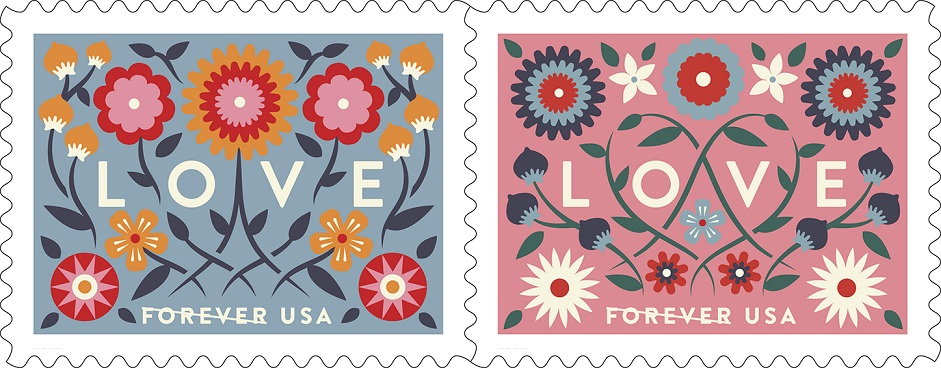
Stamps are especially costly and limited on the inside, so we buy them on the outside to help keep that lifeline going. Right now, our stockpile is running low and we need your help to keep correspondence flowing.
We’re launching a Spring 2025 Stamp Drive to send more love in the mail.
How You Can Help:
💌 Order from USPS: Purchase Forever stamps online and ship directly to us:
Shipping Address:
Adopt an Inmate
PO Box 1543
Veneta, OR 97487
💌 Find discounted stamps online: Search “Forever stamps” on eBay or Amazon. Just be sure the seller is legit. If you find a good deal, let us know — we’ll share it!
💌 Give to our general fund: We’ll use your donation to purchase stamps and other critical supplies for our mail-based outreach.
Every stamp is a bridge — between someone isolated and someone who sees their humanity.
Thank you for helping us keep those connections alive. 🐝💌
We hear it all the time: “Vote! Get involved! Pay attention!” But most of us never got a basic education in how power actually works in this country. Who makes the rules? Who enforces them? Who can change them? And what can regular people actually do when the system seems stacked against us?
Welcome to Civics 101 — a new blog series from Adopt an Inmate designed to demystify the structures that shape our lives, especially for those most impacted by the criminal legal system. Each post will break down a foundational civics concept in plain English, with a focus on justice, equity, and participation. Whether you’re a student, an advocate, or just someone who wants to understand what the heck is going on — this series is for you.
We’ll cover things like:
How a bill becomes a law (and what usually stops it)
The difference between laws, policies, and institutional rules
The roles of local officials like sheriffs, DAs, and city councils
How budgets reflect our values — and why you should care
Our goal is simple: help you understand the moving parts so you can better advocate for the people and causes you care about. Knowledge is power, and civics is the map.
We were honored to join Leilani on her podcast, There’s Danger Here for a deeply personal conversation about how Adopt an Inmate began — and why we continue this work. What started with a single phone call from jail has grown into a nationwide movement of connection, advocacy, and love.
Listen as Rick and I share our story, the roots of our mission, and what it means to walk alongside those society too often casts aside. 💌
🎧 Listen to the episode below, and follow the podcast for more interesting episodes.
The wonderful Rick and Melissa, founders of adoptaninmate, allowed me to have a conversation with them. The pair discuss how the vision came forward after their family came to an abrupt realization of what the judicial system can be for both those incarcerated and those who love the incarcerated. Now they work to change the minds of the masses, one letter at a time.
A woman who processes billing envelopes for a health system isn’t the most obvious person to spark an emotional reaction. But Emily Margolis, an accounting clerk for MJHS Health System, does exactly that. With a pen and a little spare time, she transforms bland white envelopes into tiny masterpieces—portraits, nature scenes, animals, patterns. Art that turns the transactional into something personal. Something beautiful.
Her envelope art is now being displayed in a local coffee shop, and people are touched not only by her talent, but by the gesture. The effort. The intentionality behind saying: “Here. I see you.”
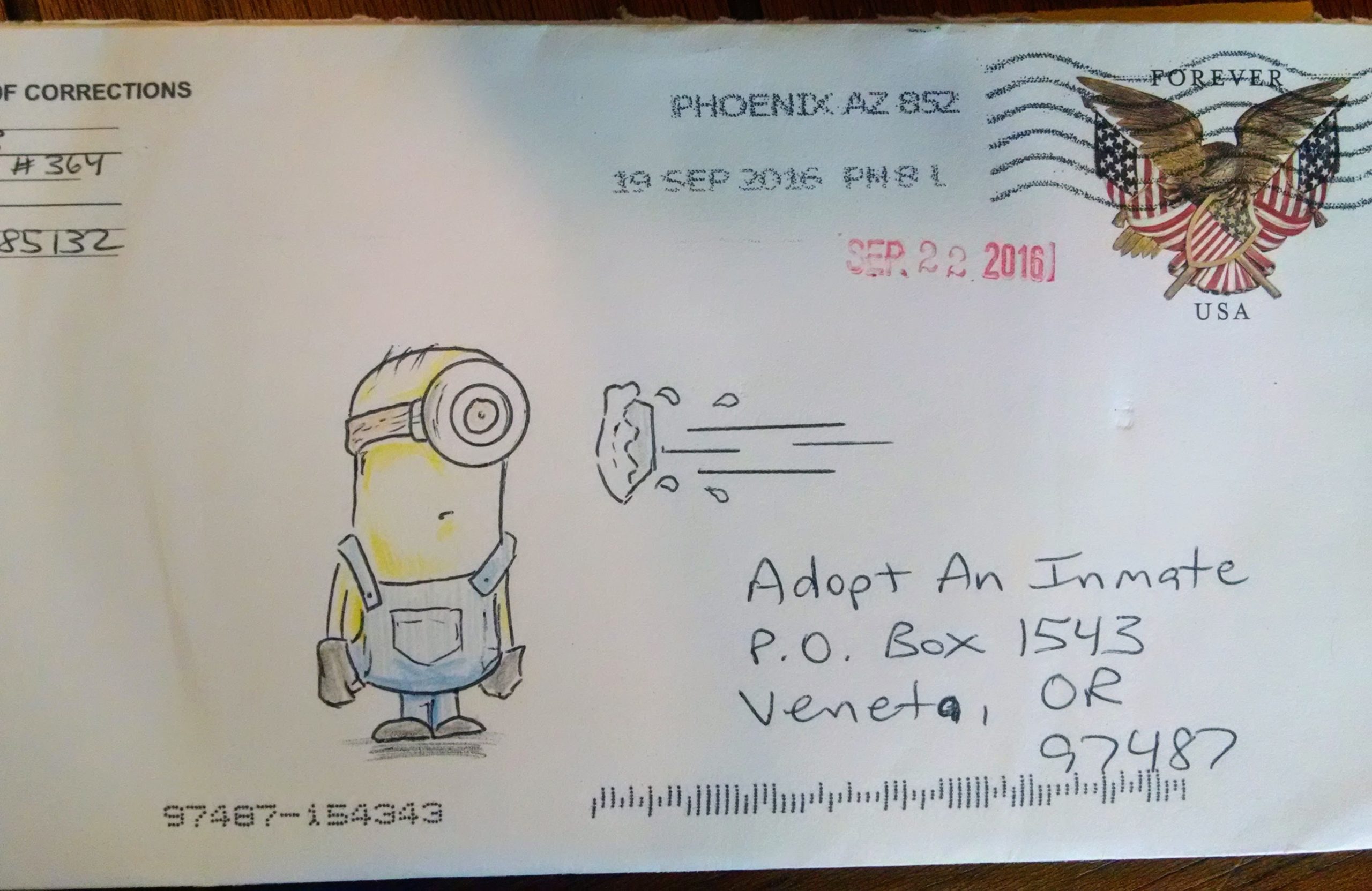
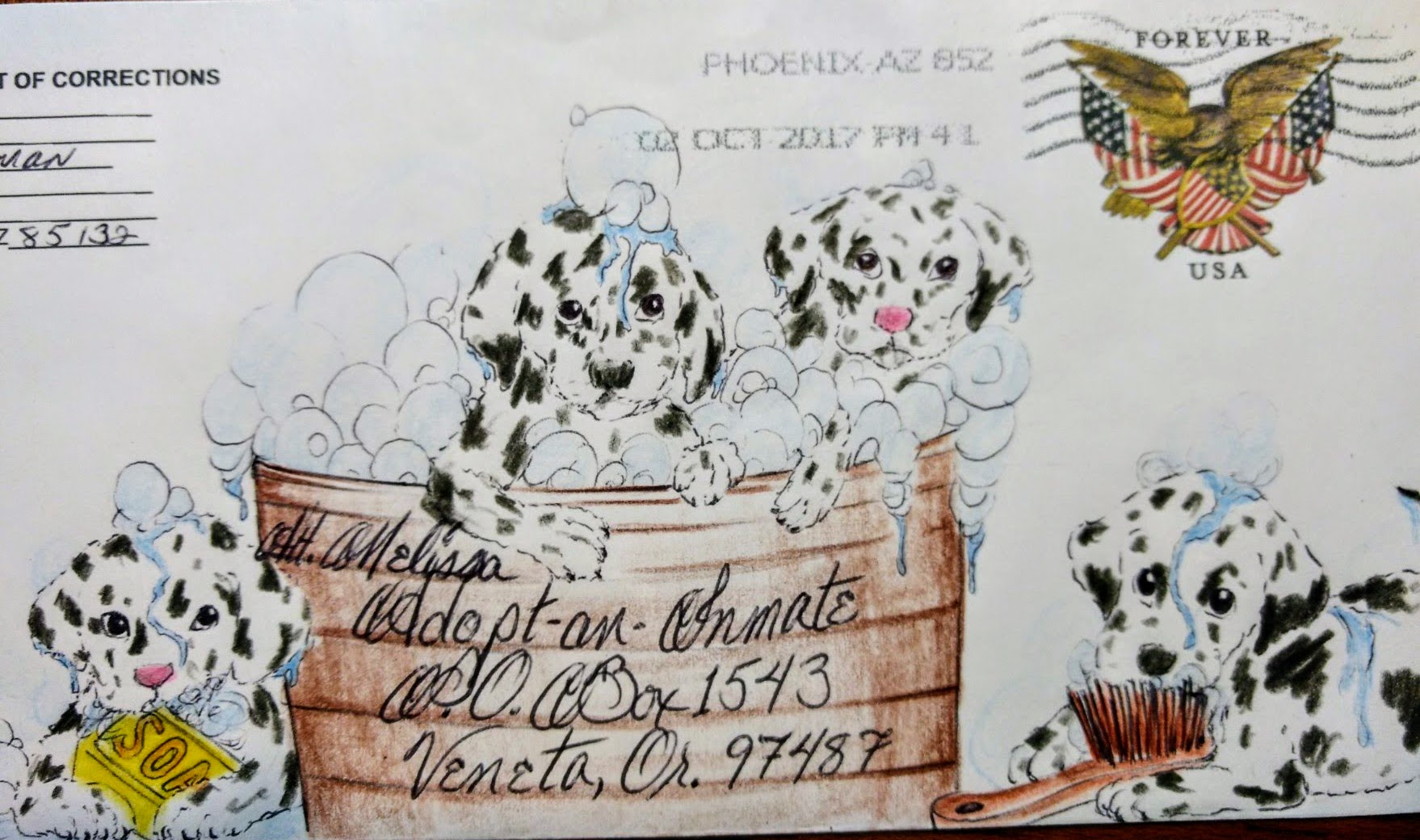
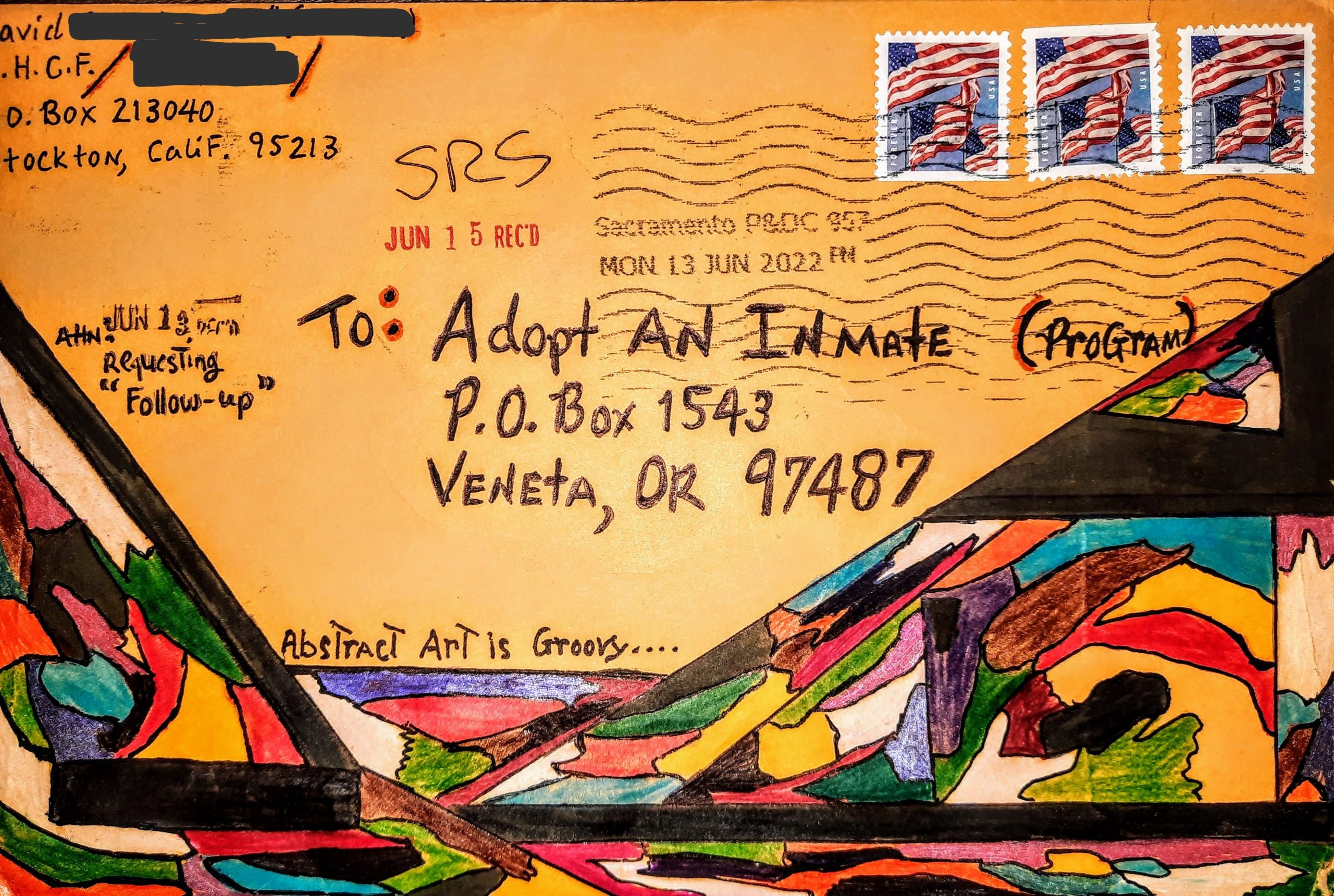
It reminded me of the people who write to us at Adopt an Inmate. Their envelopes are often adorned with flowers, doves, cartoon bees, elaborate typography, even shading techniques done entirely in pen. We’ve received artwork so breathtaking it should be framed. But more than that, it’s deeply human.
Many people in prison have little to no access to art supplies. What they do have is time, and the will to reach out. Envelope art is often the first impression we get of someone writing to us. It’s a sign of care. Of presence. Of someone reaching through the system to say:
“I’m here. I’m more than this number.”
And yet in recent years, many prison mailrooms have banned this kind of expression, both outgoing and incoming. Envelope art, or even just a colored envelope, is labeled a security risk, and rejected. Many prisons require all mail to be scanned and delivered to the person’s tablet, or as black-and-white photocopies. In those cases, the art — made with limited resources — is reduced to grainy shadows. The heart behind it, nearly erased.
We understand the need for safety. But banning creativity isn’t about safety. It’s about control. And punishment.
If envelope art from an accounting clerk can make headlines and inspire a city, surely we can see the value in honoring that same spirit in people behind bars. Their art might never hang in a coffee shop. But it still deserves to be seen.
Let them draw. Let them be human. Let them reach us.
Franz Bakery is awarding $5,000 grants to five nonprofits, and your nomination could help us win!
We love Franz Bakery not just for their bread, but also for giving back to their community. Their generosity helps small, grassroots organizations like ours do big, meaningful work. Around here, we’re especially fond of their Cherry Breakfast, 1906 Wheat, and Columbia River Sweet Dark breads. Read their inspiring story.
At Adopt an Inmate, we share that spirit of hard, honest, and meaningful work. Our nonprofit was built by and for people impacted by incarceration — those who’ve lived it, and those who’ve loved someone through it.
Help us Drop a Dime on Injustice — without spending a penny.
Franz is asking nominators for a few words (maximum 100) explaining why you’re nominating Adopt an Inmate and how our work benefits the community.
If you’d like to nominate Adopt an Inmate, here’s a bit about our organization and work:
💛 We’re a grassroots nonprofit, building human connection across prison walls.
📬 We’ve facilitated over 6,000 connections between people in prison and outside volunteers—offering friendship, mentorship, and hope.
🎓 Our STEP program partners with universities to create transformative learning through direct engagement with incarcerated individuals.
🐝 We rely on volunteers and small donations, not corporate funding.
💬 Our board includes people of color, and people who are both formerly and currently incarcerated.
📣 We just launched a national campaign — Drop a Dime on Injustice — to raise awareness through storytelling and immersive exhibit about mass incarceration. 📣
✨ If our work moves you, we’d be honored to have your nomination.
Thank you for being part of this work. Whether you’ve supported us by writing a letter, sharing a story, donating, or showing up for our campaigns — you keep this work alive.
Nominators must be legal U.S. residents 18 years of age or older as of the date of Submission and residing in (a) the states of Washington, Oregon, Idaho, Montana, Wyoming, Utah, or Alaska, or (b) Butte, Humboldt, Siskiyou, Shasta, Los Angeles, or Trinity counties in the state of California (collectively, the “Territory”).
Submission Deadline: 11:59 p.m. PST on April 30th
Essay portions of Submissions must not exceed 100 words and must be in English. The Submission must be the original work of the Nominator who entered, created and uploaded the Submission. By entering a Submission, each Nominator guarantees that he or she is the author and copyright holder of the Submission and that all content described in the Submission is truthful and accurate.
“We need more prisons because they’re full of dangerous, violent criminals.”
🔍 Fact check: FALSE.
📣 TRUTH: According to the Prison Policy Initiative, only 1 in 7 people in state prisons is incarcerated for offenses categorized as violent by legal standards. The majority are imprisoned for:
Drug-related offenses
Property crimes
Technical parole/probation violations (like missing a meeting or failing a drug test)
Many of these individuals pose no threat to public safety—but are still locked away in harsh conditions, often for years.
People in prison aren’t monsters. They’re our neighbors, our family members, and our fellow citizens—often struggling with poverty, trauma, or addiction, and in need of support, not cages.







 .
.