by Melissa Bee | Aug 17, 2025 | From the Staff
Today is National Nonprofit Day, a chance to celebrate the work of organizations around the country that serve, connect, and uplift their communities.
For over ten years, Adopt an Inmate has been building bridges between people in prison and the outside world. What began with a single incarcerated family member has grown into a nationwide network of volunteers, adopters, and supporters who refuse to let anyone be forgotten behind bars.
💌 Together we’ve:
- Matched thousands of people in prison with caring adopters
- Built a nationwide network of volunteers who give their time, talent, and heart to people inside
- Received and processed countless letters and applications
- Created opportunities for university students and professors to engage directly with people in prison
- Shared stories that shine a light on injustice while affirming humanity
None of it happens without you. Your time, your stamps, your donations and your heart fuels every letter and every connection.
If our work has touched you, today’s a perfect day to show your support:
👉 Donate today
👉 Give stamps
by Melissa Bee | Aug 17, 2025 | From the Staff, Your Sunday Read
Happy Sunday Friends,
This week we’ve been shining a spotlight on prison mail restrictions. Every single day, letters, postcards, and envelopes are returned to us stamped “Rejected,” “Refused,” or simply “Return to Sender.”
We’ve shared just a small sample of those rejections this week. Each returned envelope represents a broken connection, wasted postage, and one more person inside cut off from the outside world.
When Connection Hits a Wall: Five Stories From This Week’s Mail Rejections
- Oregon’s Envelope Ban
Security envelopes — the kind we use every day — are now banned in Oregon. Even envelopes purchased inside and mailed to us are being rejected.
- Tennessee Goes Digital
As of August 1, Tennessee routes all personal mail through a third-party scanning service. The result is delays, poor quality copies, and zero privacy.
- No Postcards For You!
From photos and postcards, letters written on diner placemats, and children’s crayon drawings, these cherished personal mementos are now banned in most federal and state institutions.
- Mystery Rejections (Oklahoma)
Return to Sender. Refused, Unable to Forward. The recipient was still in custody, the info was correct, and yet…rejected. This was how we discovered Oklahoma has quietly gone digital.
- Mystery Recipients
Frequently, the mailroom slaps a giant sticker over the intended recipient’s name and ID, leaving us no way to know who the letter was meant for.
The reason given for all these restrictive mail policies is always “security,” and to reduce contraband. But does that really add up?
Evidence Check
- No solid proof mail scanning works. After instituting mail scanning, the percentage of incoming mail that the Department of Corrections reported as “tainted” only decreased by 0.1% over the course of a year. As of 2023, the rate of positive drug tests in Pennsylvania prisons is now almost 3 times higher than it was before the policy was introduced.
- In Florida, of the 3.1 million contraband items that entered the prison system from January 2019 to April 2021, only about 1 percent came in through mail.
- Texas prisons stopped in-person visits and limited mail, but that didn’t stop drugs from getting in.
- It’s the guards, stupid. Reports confirm that most often, it’s staff—not “drug-soaked papers”—that bring contraband into facilities. In many cases, contraband enters through corrections staff—not mail. That includes drugs, K2, and cell phones. The BOP imposes no restrictions on the personal property BOP staff can bring into the institutions, does not search staff or their property when they enter for duty, and does not conduct random drug testing of staff.
Have you had mail returned or rejected? Have you seen policies change in your state? We’d love to hear your story. Comment below, and/or use this form to help us track mail policies nationwide.
As always, thanks for reading, sharing, and supporting.
With gratitude,
—Melissa
Quote of the Week:
“Mail from home was so important when you were traveling. It kept you in touch with the familiar, even the part you were running from.” – Helen Van Slyke
PS: On the home front, we’ve been told to expect an update from our insurance company soon about what (if anything) will be covered from the water damage in our kitchen. Insurance companies follow closely behind prison mailrooms when it comes to delays and absurd policies that benefit only themselves.
On the brighter side, I’ve perfected single-serving rice in the egg cooker (who knew?), and am still on the hunt for more off-label uses. (Read last week’s installment here.)
Donate Stamps – SOS: Stamp out Silence!
Take the Quiz – How much do you know about U.S. prisons?
Give – Help us keep breathing together
Add Your Voice – Submit your responses to our Good, Bad, Change poll
by Melissa Bee | Aug 16, 2025 | From the Staff, Hate Mail
We’re wrapping up this week’s series on prison mail policies with one last return from a prison mailroom … somewhere.
We’ve saved one of the most infuriating for last, and it isn’t just one prison being careless. It’s a tactic used in many states: Placing the return label directly over the recipient’s name, and address. That means the letter didn’t just get returned, but the mailroom erased the person it was meant for.
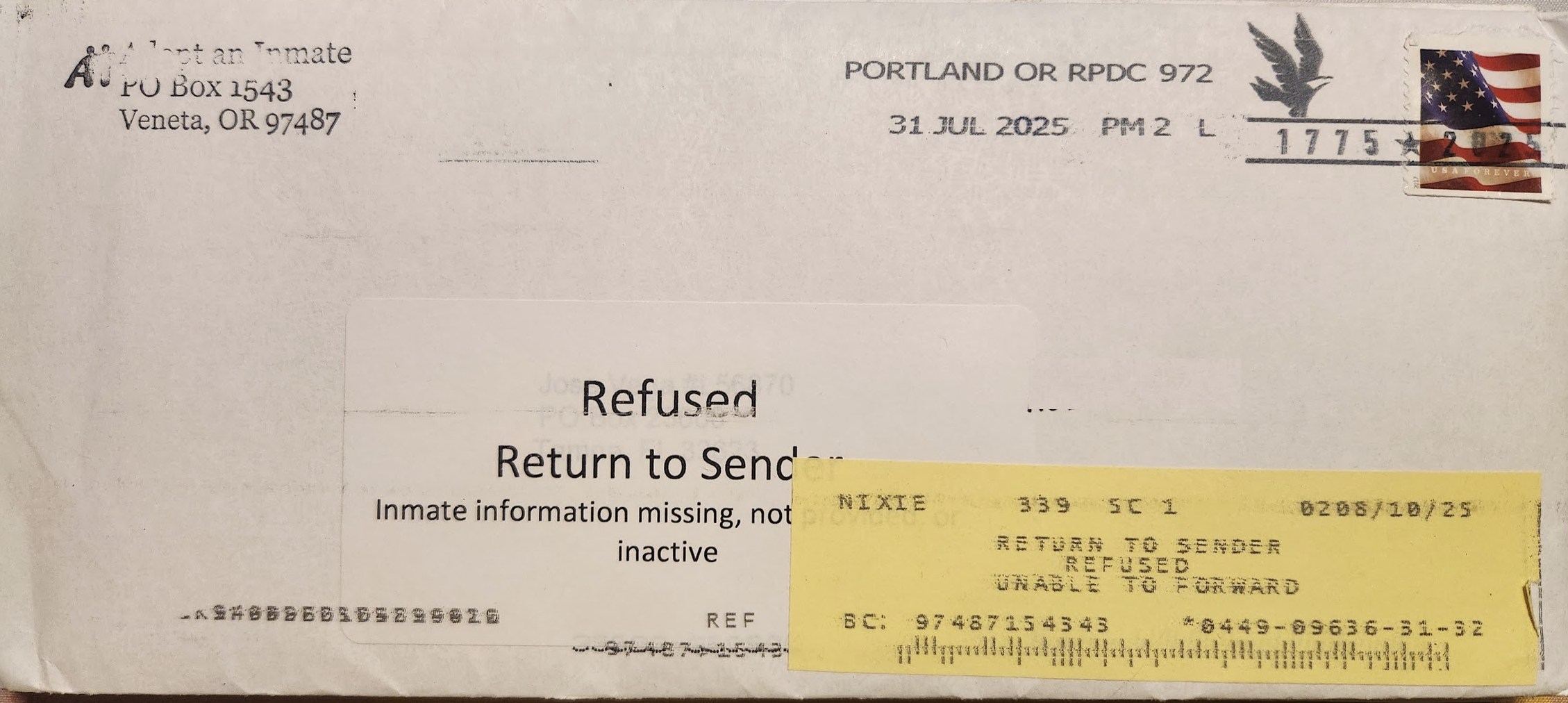
“Refused – Return to Sender – Inmate information missing, not found, inactive.”
So not only was this person denied their mail, but we have no way of knowing who it was supposed to reach.
This is how arbitrary and dehumanizing prison mail policies can be. A single carefully placed sticker thwarts the message of hope inside.
Thanks for (literally) nothing.
But we’ll keep on mailing, and keep on speaking out. Because even when mailrooms silence voices, we won’t.
by Melissa Bee | Aug 15, 2025 | From the Staff, Hate Mail
This week we’ve been sharing a handful of our daily mail rejections — the kind of maddening, head-scratching returns that land in our PO Box almost every single day.
Here’s one for the “You Can’t Make This Stuff Up” file.
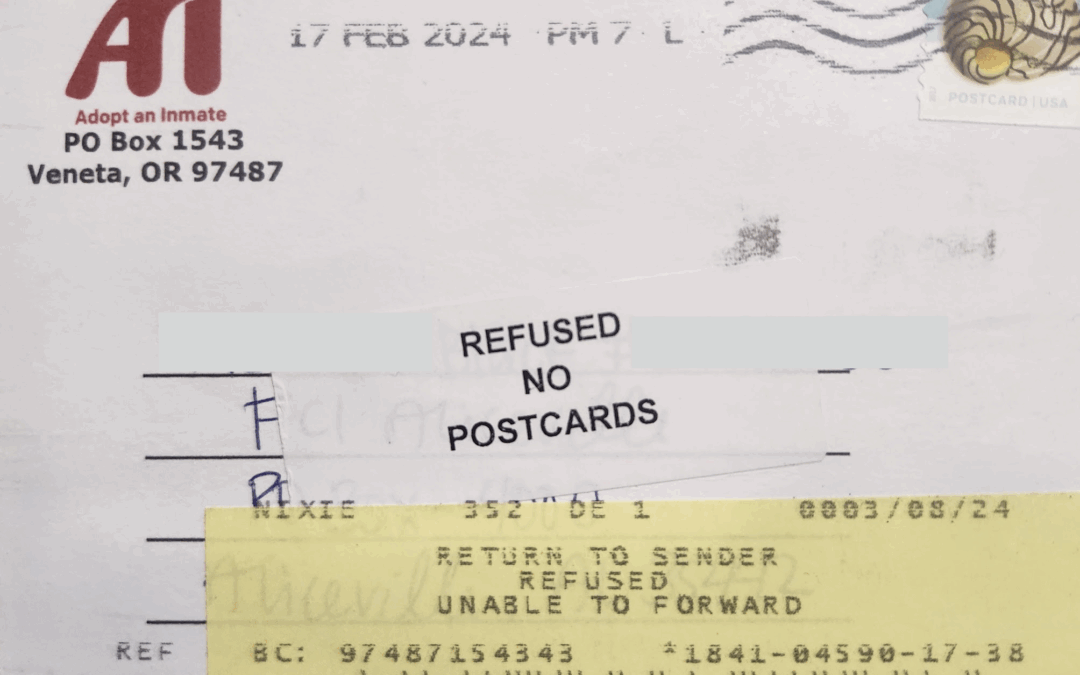
This envelope, along with several others for the same institution, came back to us marked Return to Sender — Refused, Unable to Forward, with no explanation. These RTSs were self-addressed stamped envelopes provided by the prisoners to us at their own expense, complete with their full name, correct ID number (redacted here) and mailing address.
As is our standard practice before mailing anything to someone in prison, we checked the official agency locator, in this case Oklahoma DOC, and confirmed that the recipient was still in custody and had not been moved or released. The envelope contained no contraband — just a standard application with a short handwritten note from our volunteer Liz, and sent out with all the outgoing mail prepared during our annual volunteer weekend last month.
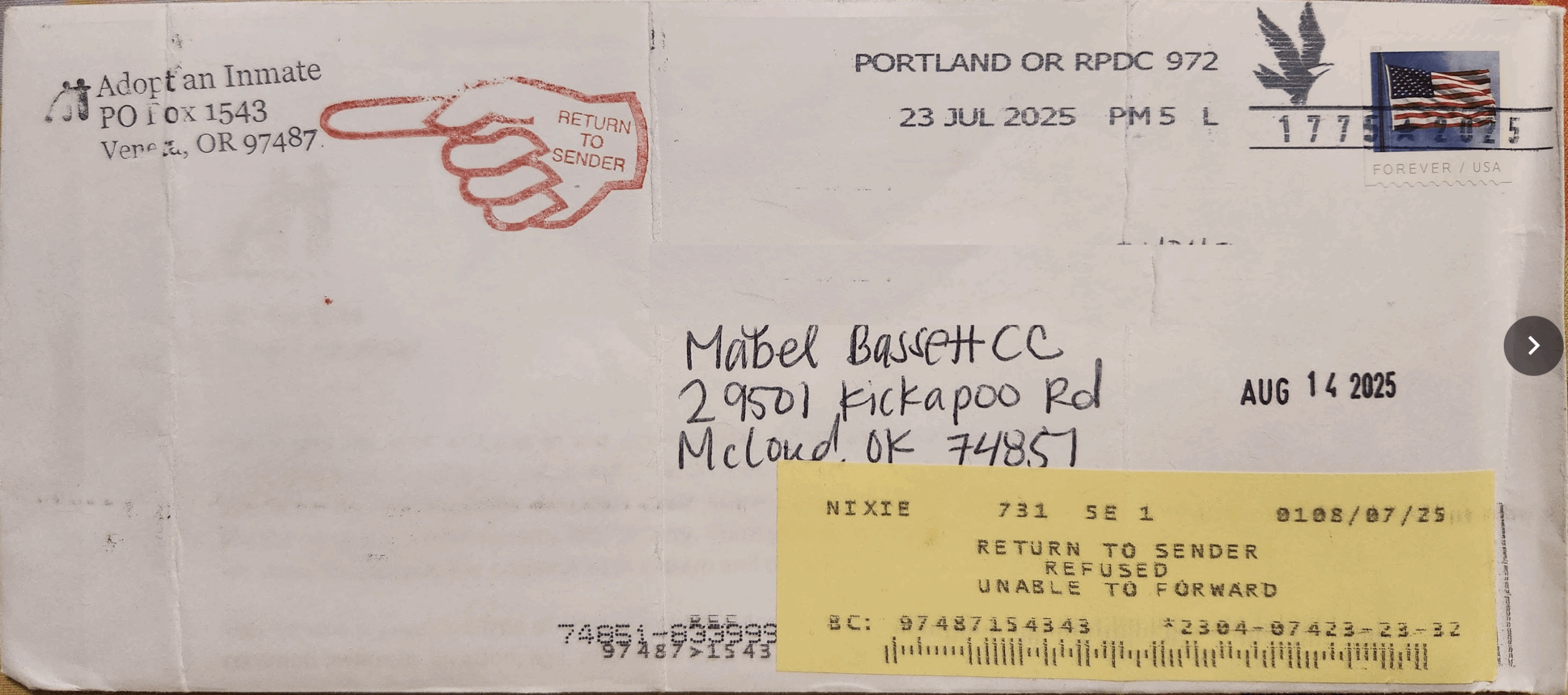
Here’s the kicker: after some digging, I discovered Oklahoma DOC has joined the parade of states that has switched to a digital mail system. Their web page about the change even claims people in custody know about the change.
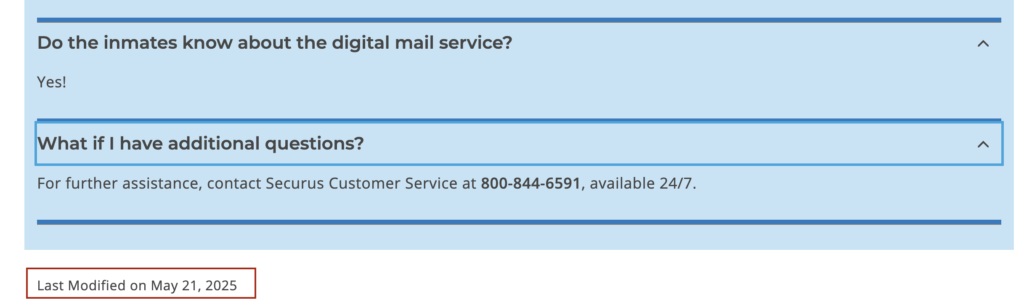
Riiigggghhhhht. So why were SASEs with the old address allowed out through the mailroom? And how are folks supposed to update their outside contacts if their own envelopes with the wrong address are being returned without explanation?
These unexplained refusals waste time, waste resources, and cut off people inside from essential communication while making the outside world do detective work just to learn the real reason.
Sure. Tell us again that prisons support and encourage outside contact.
by Melissa Bee | Aug 14, 2025 | From the Staff, Hate Mail
No postcards for you!
Before email and text messages, some of the most treasured connections came in the form of a simple piece of mail. For me, that meant letters and postcards from my grandparents as they traveled the country. From the road, my grandmother would write to us on the paper placemats you used to find in roadside diners. They were often printed with the restaurant name, the city, maybe a few fun facts about the area, or a puzzle to solve. She’d write her letter on the back, and drop them in the mail, sometimes tucking in a postcard from wherever they’d stopped.
Those letters and postcards from the road remain cherished reminders of their constant presence even when we lived in different states.
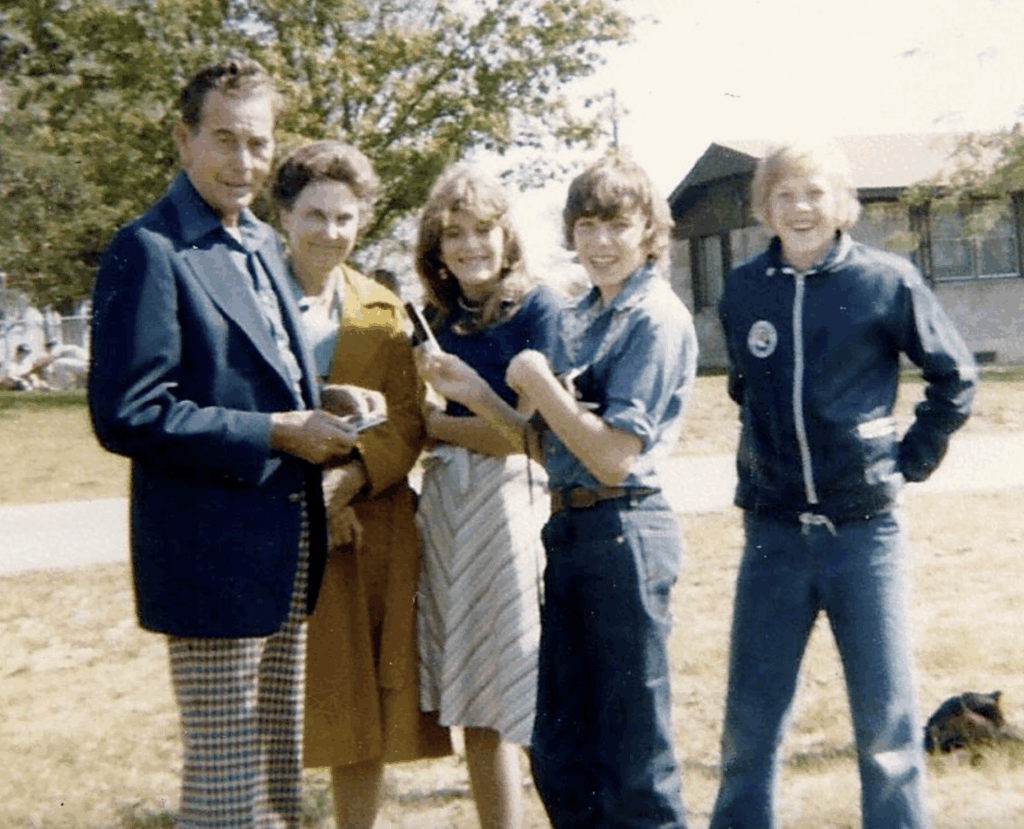 This picture is one of those reminders. It had to have been 1977, and my mom, my brother and I were living in Oklahoma, just outside of Tulsa. We’d had maybe a day or two’s notice that our grandparents would be stopping for a visit while on the road in their camper. Our neighbor and school friend Mike wandered over, and we lined up for a picture. It must have been a Sunday. We were dressed for church.
I cherished those letters and cards, and still have some of them. I can only imagine how much more these mementos are for people in prison, cut off from the world and hungry for any glimpse of life beyond those walls.
But in federal custody, and an increasing number of state institutions, people aren’t allowed to receive postcards. Some state facilities go the other way and allow only postcards. No letters on paper (or diner menus) at all. Only what can be crammed onto one side of a 4″ x 6″ card.
With stamps now 78¢, we save a little by using 61¢ postcards for short messages like adoption notices, congratulations, or quick answers. When they’re refused, it’s more than wasted postage. It’s extra labor to resend, delays in delivering news, and one less thread of connection.
Policies that prohibit postcards and other personal touches strip away the most human and tangible reminders that someone, somewhere, thought of you and took the time to send a piece of their life. For people inside, these simplest keepsakes that mean the world, may never make it into their hands. And that’s a loss worth talking about.
by Melissa Bee | Aug 13, 2025 | Uncategorized
Prison is one of the last places where a handwritten letter still matters, but prison agencies have been putting that under threat for over a decade.
Starting August 1, 2025, Tennessee began rerouting all incoming personal mail through a third-party scanning service. Instead of receiving physical letters, incarcerated people now get digital scans or printed copies. Administrators say this policy aims to curtail contraband smuggling. But does it?
What this means for families:
- Delays in mail delivery.
- Lower quality or incomplete content as photos and kids’ artwork lose their meaning through photocopy.
- Privacy risks — a private vendor now handles and stores intimate correspondence.
- Disconnected emotions — no more touching the paper, feeling the weight of a handwritten note, or keeping a card as a lifeline.
Meanwhile, the evidence shows that mail scanning doesn’t stop contraband.
You can read Tennessee’s official FAQ here: Tennessee DOC Mail Scan FAQs (PDF)
Once again, in the face of these ever-changing policies and increased restrictions, we’re updating our guides and helping families adapt. Every new restriction makes staying in touch harder, and hope feels more fragile. The sad and frustrating truth is, every new barrier to personal mail makes it harder to sustain relationships across prison walls. Those relationships are what keep hope alive for people in prison who are fortunate enough to have any outside contacts.
Have a story about returned mail? Please share in the comments (scroll alllll the way down below), or use this form and help us track this practice across U.S. prisons.
💌 Donate Stamps – SOS: Stamp out Silence
❤ Give – Help us build a world where no one is forgotten
by Melissa Bee | Aug 12, 2025 | From the Staff, Policy vs. People
At Adopt an Inmate, the mail isn’t just part of our work — it is our work. Prison is one of the last places where letter-writing is still a lifeline. For the people we serve, a letter can be the highlight of the week, a link to the outside world, and sometimes the only reminder that they are not forgotten. That’s why every new mail restriction isn’t just a policy change — it’s another wall between people and those who love them.
That’s why we spend so much time tracking prison mail rules, helping families navigate them, and scrambling to keep up when those rules change. As someone who has seen frequent mail policy changes over the last ten. years, I can confidently say that the changes are never for the better. Over the decade we’ve been doing this work, we’ve seen bans on:
- Colored envelopes
- Blank stationery of any kind
- Address labels
- Calendars
- Stickers (this includes postage stamps)
- Post cards
- Letters written in any language other than English or Spanish
- Greeting cards — first musical or multi-layered cards (like pop-ups), then cards in colored envelopes, then any cards, period
- Photos
Long gone are the days when loved ones could send a colored drawing from a child or a scented letter. Many states have banned greeting cards or pictures unless they are mailed directly from an approved vendor — which means no handwritten notes on cards or on the backs of pictures. Every way someone in prison could receive something their loved one touched… banned. Returned to sender, and often at the expense of the prisoner, who never got to see or touch it.
The worst ban is on any physical mail at all. More and more states are moving to digital mail services, where mail is scanned and a picture of the letter is forwarded to the intended recipient’s tablet. Isn’t that warm and fuzzy?
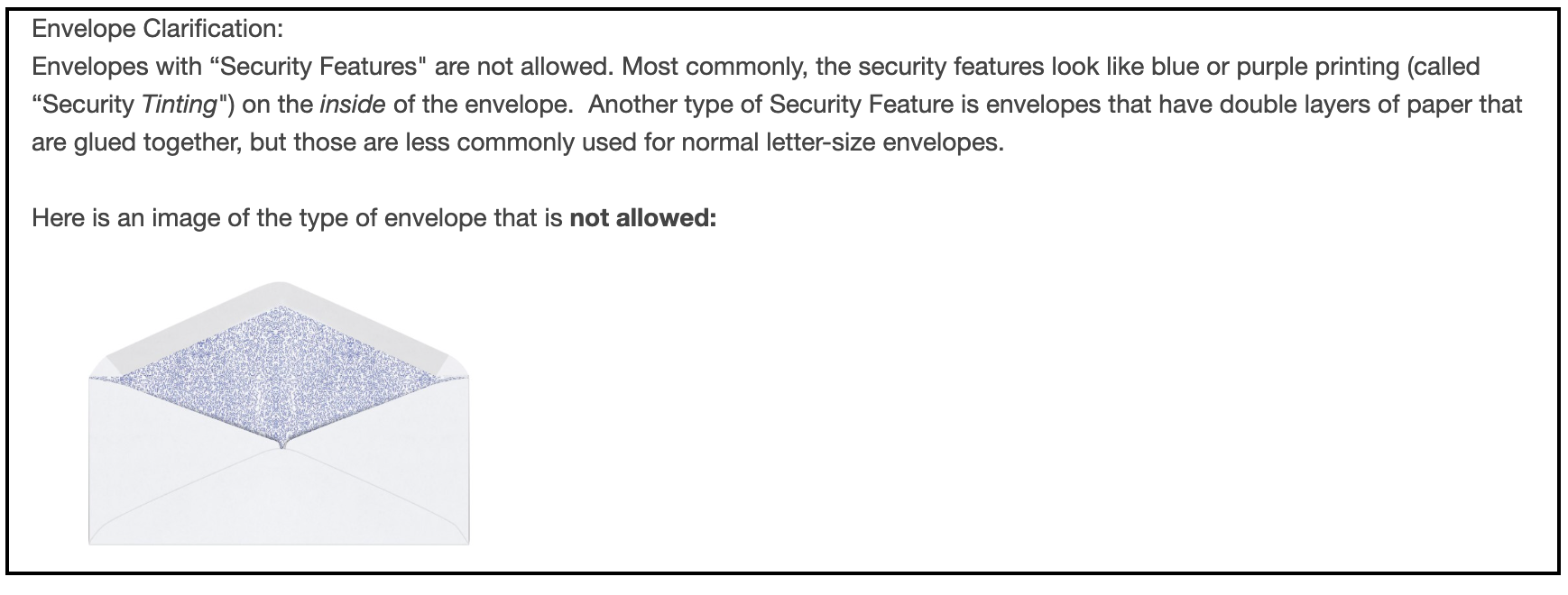
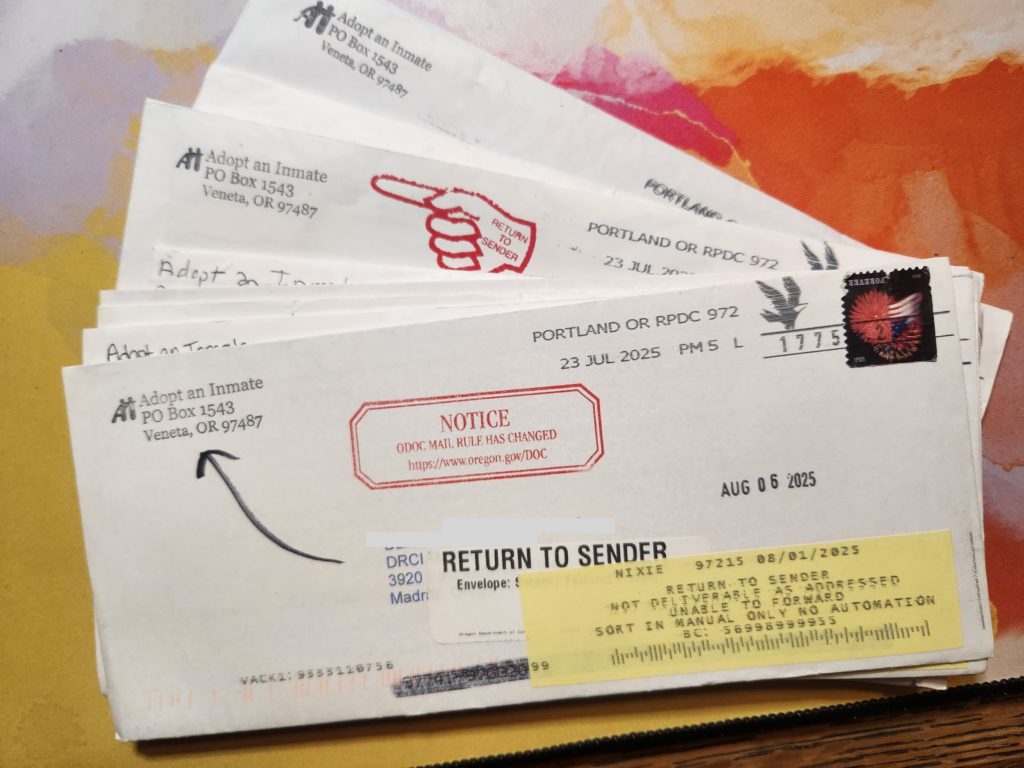
Our latest round of Return to Sender mail comes from Oregon prisons. The reason? A new Oregon policy banning envelopes with “security features.” These are the envelopes with blue or gray printed patterns on the inside — the same kind you’ll find in most offices and homes.
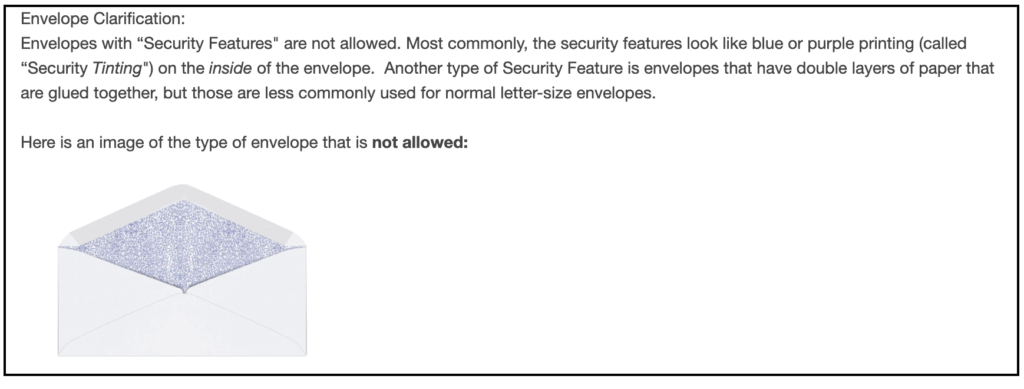
For us, this is a problem. We buy boxes of 500 self-sealing envelopes at a time to keep things moving smoothly. Have you ever tried to find self-sealing envelopes without that inside print? Nearly impossible. And to make matters worse, the ban applies even to envelopes purchased by prisoners themselves — including self-addressed stamped envelopes (SASEs) that they send to us so we can reply.
Self-addressed stamped envelopes (also known as SASEs) are gold to us. Postage is one of our biggest expenses, so when someone inside sends a prepaid envelope, it goes to the top of our reply pile so we can respond quickly. Now, under this policy, those envelopes — bought with their own limited funds through commissary — are being returned.
The result? More delays. More wasted postage. More roadblocks between people inside and the outside support they desperately need.
This is just one more example of how mail restrictions chip away at human connection in prison. The people who pay the price aren’t the ones who wrote the rules — they’re the families, friends, and advocates trying to keep relationships alive across walls and razor wire.
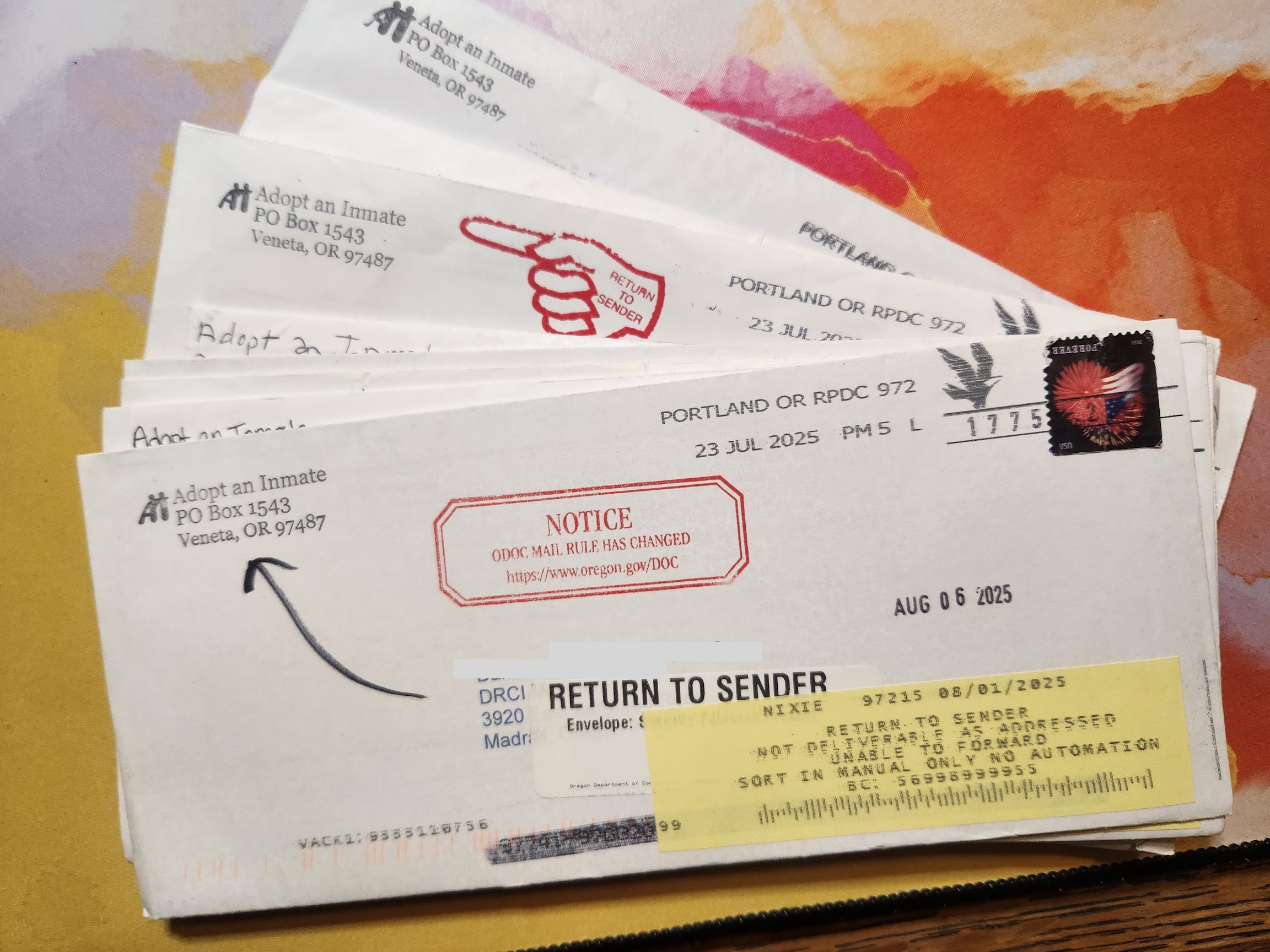
This is the stack of returned letters we’ve received under this new policy in the first two days of this week. Each envelope is a story interrupted, a conversation cut short. And for what?
Because if there’s one thing we’ve learned, it’s this: prison mail policies rarely make prisons safer, but they always make people lonelier.
Stay tuned this week for more stories about prison mail policies — and the truth about their effect on contraband.
Have a story about returned mail? Please share in the comments (scroll alllll the way down below), or use this form and help us track this practice across U.S. prisons.
by Melissa Bee | Aug 10, 2025 | From the Staff, Your Sunday Read
Hi Friends,
The summer days are long, the mornings warm, and cold brew is on the breakfast menu these days. ☀️ So pour yourself a cup (or grab a glass of something iced), find a shady spot, and settle in.
Here’s what we shared this week on the blog (links near the bottom):
- Art From Prison: Meet Victor the Convict, a sharp and endearing comic that says a lot with a few words and some fine pencil artwork.
- Good, Bad, Change: Two responses from inside: Troy, sharing his observations from a Texas prison, and Reynold, from a super-max prison in Pennsylvania.
Last week I asked what you would do if you spotted a spider in an audience member’s hair during a live symphony performance. Leah and I hadn’t talked since that night until today, but she says she saw the spider too and noticed someone in front of her who started to tell her (twice!) but never did. No one commented, but I’m still wondering what you would have done, and it’s not too late to chime in. Read the post here and weigh in.
Meanwhile, in my own home, we’re living a little closer to cell reality than we expected.
Some of you may recall the mitigation work from our water leaks wrapped up a couple of weeks ago (picture several surprise waterfalls inside the wall), but we’re still waiting on our insurance to decide if the loss is covered. If! Sigh.
That means six weeks (so far) without a kitchen. No stove. No counters. All the lower cabinets and the island? Removed and trashed. The microwave and fridge are holding the fort, but it’s been a long run of reheated meals and takeout tabs.
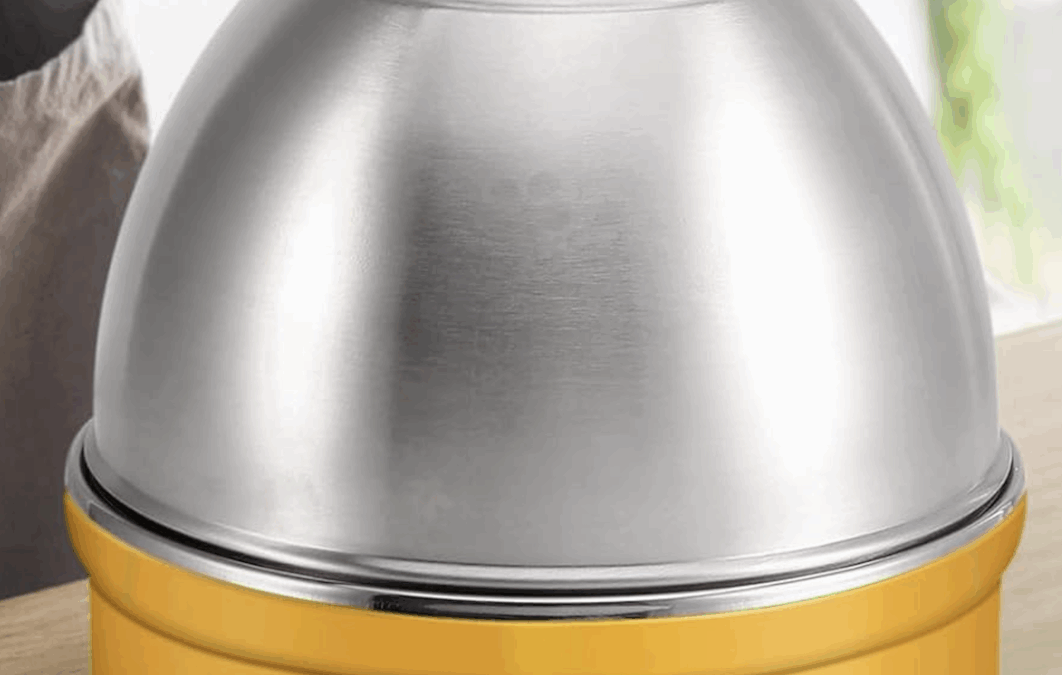
So, in a moment of weakness (or brilliance), I bought a countertop egg cooker.
I’m normally anti-single-use appliances, but this one is tiny, only needs water, and can steam other things (in small amounts) like single-serving frittatas, dumplings, and veggies.
It made me think of cooking in a prison cell, where a hot pot is your entire kitchen. The constraints are real, and so is the creativity that comes out of them.
We do have an electric kettle, a microwave, and a fridge. The challenge is cleanup: no sink, no disposal, and a strong desire to avoid balancing a greasy pan over the bathroom basin. Because ew.
So here’s your new challenge: What can I make with an egg cooker that isn’t just eggs?
Bonus points if it requires minimal prep and is easy to clean up.
I’ll try your suggestions and report back.
🐣 Read this week’s posts:
Victor the Convict – Art From Prison
Good, Bad, Change – Troy in Texas
Good, Bad, Change – Reynold in Pennsylvania
Quote of the Week:
Do what you can, with what you have, where you are.
— Theodore Roosevelt
Thanks for reading, sharing, and supporting. Now do tell me your genius ideas for what else we can make in a tiny egg cooker… I’m ready to push it to its limits. (To leave a comment, scroll… keep scrolling… yep, past the “You May Also Like” section… farther… there you go! The comment box is hiding way down at the bottom.)
With gratitude,
—Melissa 🐝

by Melissa Bee | Aug 8, 2025 | From the Inside, Good Bad Change
This series shares reflections directly from people impacted by the criminal legal system – what gives them hope, what causes harm, and what they believe needs to change. Each voice is unique, but together they reveal the urgent need for a more just and humane approach.
ADD YOUR TWO CENTS – scroll to bottom of post for instructions
Want more posts like this? Subscribe to our blog
Reynold in Pennsylvania
In our Good, Bad, Change series, people inside share their perspectives on life behind the walls—what’s going well, what’s not, and what changes they hope to see.
The Good
Access to educational and vocational programming. Every state prison in Pennsylvania has different opportunities and there are a lot of positive things here where I am. I received my OSHA and Flagger’s Certificates, and am currently working on receiving my GED. I’m also on the waiting list for “Thinking for a Change.”
The Bad
We have here what is called “Violence Reduction Strategy.” Meaning if a fight breaks out and you are just standing there and don’t have anything to do with it, Security will send you to the hole for investigation based on you standing there. Another harmful problem is that the UA tests have false positives. The brand of the test is “Redwood Technology Inc.”
The Change
One thing I would change about the system is to make it equal and fair, so that everyone would come together and be united, and stand up for one another together. Men and women are supposed to fight their cases, not each other!
Share Your Good / Bad / Change
What stood out to you in Troy’s reflections? What gives you hope, what causes harm, and what would you change? We welcome thoughts from both inside and out. (Scroll down to the comment section.)
Snail mail:
Adopt an Inmate
Good Bad Change
PO Box 1543
Veneta, OR 97487
Online:
Use this form ← click on the link to open
E-mail: submit@adoptaninmate.org
🗣️ Share Your Story – How has incarceration affected you or someone you love?
✍️ Take the Quiz – How much do you know about U.S. prisons?
💌 Donate Samps – Stamp Out Silence!
❤️ Give – Support dignity, connection, and second chances.
by Melissa Bee | Aug 7, 2025 | From the Staff, Good Bad Change
This series shares reflections directly from people impacted by the criminal legal system – what gives them hope, what causes harm, and what they believe needs to change. Each voice is unique, but together they reveal the urgent need for a more just and humane approach.
ADD YOUR TWO CENTS – scroll to bottom of post for instructions
Want more posts like this? Subscribe to our blog
Troy in Texas
Today’s submission comes from Troy, who has spent over thirteen years in the Texas Department of Criminal Justice. As a life coach and peer educator, Troy works every day to help others grow, even while wrestling with his own pain. In his own words, here’s what’s good, what’s bad, and what he believes must change.
I’ve been incarcerated in the Texas Department of Criminal Justice for nearly thirteen and a half years of a 25-year sentence. I’ve been at the Ferguson Unit trusty camp for only a few months, but I’ve been in and out of prison since 1985. It’s painful to admit — sometimes I feel like “damaged goods,” like an unwanted package in the returns box.
It’s only by God’s grace and mercy, and the personal relationship I have with Him, that I am in my right mind today.
The Good
I don’t think there’s really anything good about being in prison — but I have learned some things that can be beneficial. There are self-rehabilitative programs, self-help classes, and a variety of educational opportunities: GED, academic courses, vocational and college trades, correspondence Bible studies, life coach training, and more.
Most programs have requirements to enroll, but there’s something for almost everyone. I am presently a life coach, and I’ve held other assignments like Support Service Inmate, law library clerk, general library clerk, and peer educator.
It takes a lot to weather the storm of incarceration and stay focused on your goals, especially when you’re surrounded by negativity and people who don’t support rehabilitation or sobriety.
The Bad
There’s good and bad in every person, but prison can be a dangerous place depending on the unit, the people, and your perspective.
Some officers are just as negative-minded as some inmates, and one bad interaction can escalate into something worse. Drugs and alcohol are rampant; K2 is destroying minds and lives. The violence can be constant — some days feel like living inside a TV drama where anything can happen without warning.
I’ve seen small conflicts that could be solved with a conversation turn into violent incidents. I’ve seen parole denied again and again for reasons tied only to someone’s past, with no regard for their present progress.
Inconsistency is another problem. One officer will enforce a rule, another will ignore it. Some treat certain groups of people differently because of race or custody level. These small things create unnecessary tension that can turn ugly fast.
The Change
There should be common ground in how officers interact with incarcerated people — not an “us versus them” mentality. Rules and expectations should be consistent, communication clear, and the focus should be on safety and well-being for everyone.
The parole system should consider the progress a person has made, not just their past. Anyone who has served a substantial portion of their sentence, maintained good conduct, and participated in rehabilitation should at least be considered for release or placed in a reentry program.
Rehabilitation should be available to everyone, regardless of custody level. The people who act out the most are often the ones hurting the most — masking pain with anger because it’s the only way they know to survive.
As a life coach, I’ve been teaching for over two years. Some days, I’m nursing my own pain while trying to help others. I put my feelings aside and focus on the issue at hand, and it gives me a sense of worth.
I cry within my spirit every night because I feel so broken sometimes. But at the end of the day, I’m thankful to be alive and in my right mind.
“I have been praying for someone to reach out to us… and show us that we do matter, that we do exist, and that there are people who actually care. There’s a lot of pain and hurt within this prison system, and it’s not the kind you can physically see or touch — it’s buried deep within a person’s soul.” – Troy
Share Your Good / Bad / Change
What stood out to you in Troy’s reflections? What gives you hope, what causes harm, and what would you change? We welcome thoughts from both inside and out. (Scroll down to the comment section.)
Snail mail:
Adopt an Inmate
Good Bad Change
PO Box 1543
Veneta, OR 97487
Online:
Use this form ← click on the link to open
E-mail: submit@adoptaninmate.org
🗣️ Share Your Story – How has incarceration affected you or someone you love?
✍️ Take the Quiz – How much do you know about U.S. prisons?
💌 Donate Samps – Stamp Out Silence!
❤️ Give – Support dignity, connection, and second chances.