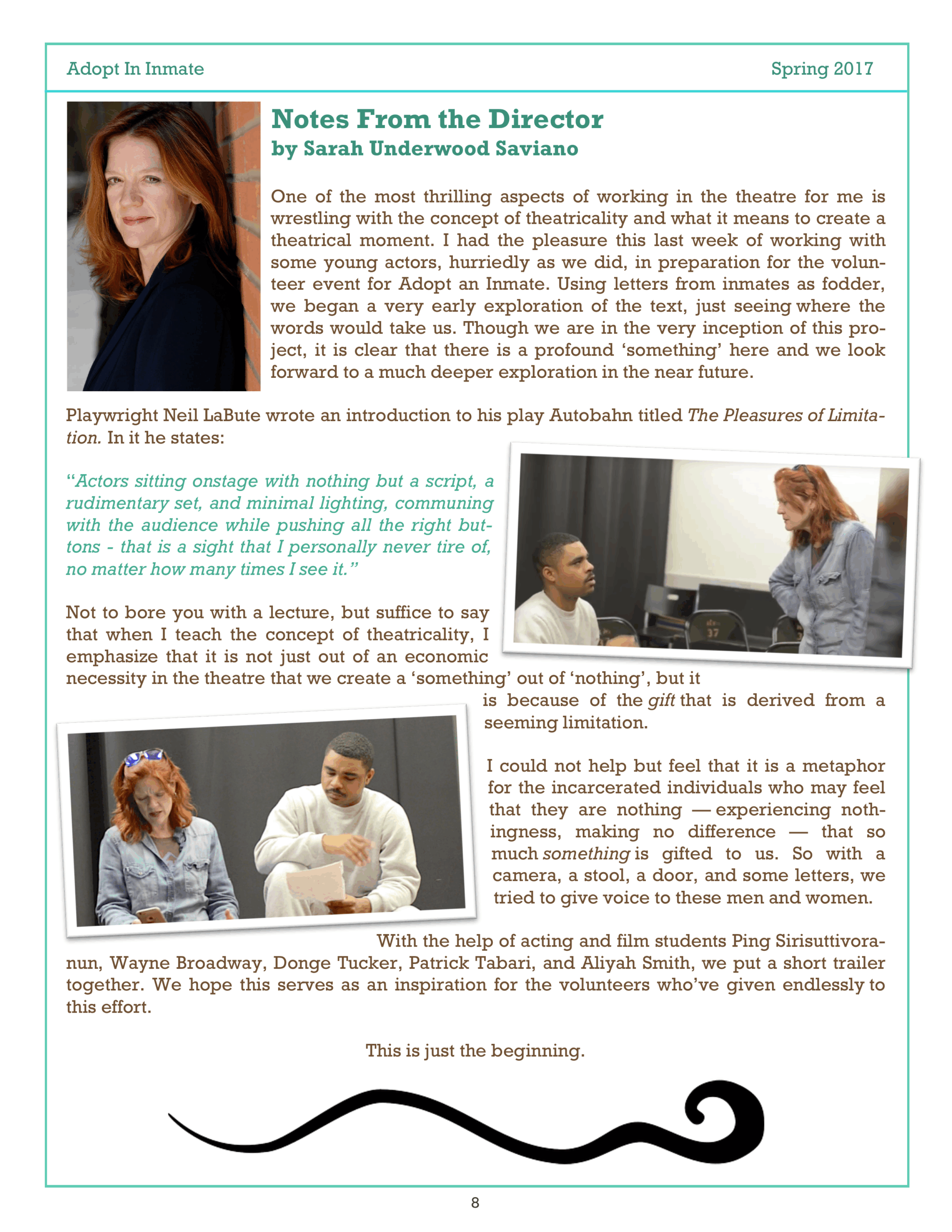
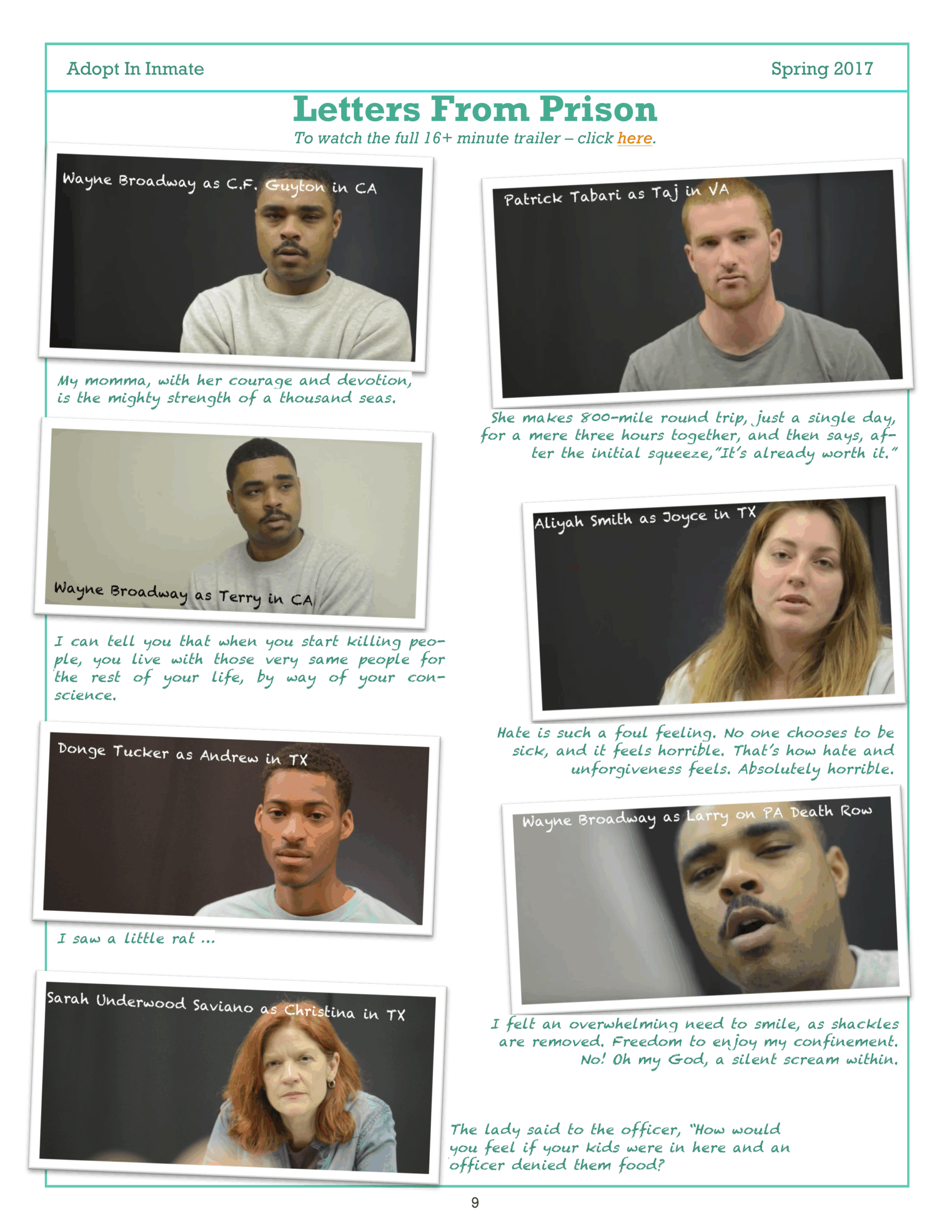
On Mother’s Day, we’re reviving a scene from a project we did in 2017. To read the poem, click here.
In this moving piece titled My Momma, one writer behind bars paints a vivid portrait of love, memory, and resilience. Read by theater student Wayne Broadway in our Letters from Prison video series, it’s a reminder that even from behind walls, gratitude and reverence still bloom.
We asked Sarah Underwood Saviano, the director of our Letters From Prison video series, to reflect on the process of bringing these powerful words to life.
💬 The Good: What’s one positive thing you’ve seen or experienced in prison?
Tablets with access to educational materials and messaging (Emessage/phone).
💬 The Bad: What’s one negative thing you’ve seen or experienced in prison?
The lack of access to mental health care, and the widespread excessive overuse and policies of indefinite “administrative segregation” which can further deteriorate one’s mental stability, cause mental distress/instability, and emotional instability. Staff abuse, misconduct, and retaliation. Inhumane living conditions.
💬 The Change: If you could change one thing about prison, what would it be?
That the incarcerated population were treated like human beings, with respect, and set them up for success, not failure.
💬 For Adopters, Family, and Other Advocates: Please tell us about your experience supporting someone in prison.
Advocating for the incarcerated has been the most enlightening and rewarding thing I’ve ever done. Witnessing their self growth, compassion for others, and drive to better themselves as well as those around them is absolutely amazing.
⏩Forward This Email – Someone needs to see this
📢 Add Your Voice – Submit your responses to our Good, Bad, Change poll
✍️Take the Quiz – How much do you know about U.S. prisons?
People end up in prison for all kinds of reasons, many of which have nothing to do with actual guilt or deserving punishment. Racism, poverty, mental illness, addiction, bad representation, coercive plea deals, or just being in the wrong place at the wrong time can all land someone behind bars. Innocence is rarely enough.
Let’s break it down:
✅ One in 5 people in U.S. prisons has not been convicted—they’re jailed pretrial, often because they can’t afford bail.
✅ Coercive plea deals mean many people take guilty pleas just to avoid longer sentences, not because they’re guilty.
✅ Studies estimate 4–6% of people in prison are innocent—which amounts to over 75,000 people in the U.S. alone.
✅ Juveniles and people with mental illness or intellectual disabilities are routinely punished instead of supported.
Additional Context
Even if someone committed a crime, the system doesn’t account for trauma, survival, or systemic failure. Not every wrong act requires a cage. And some of the people who most need care are the ones being punished the harshest..
Take five minutes today to look up your representatives – local, state, and federal. These are the people who vote on funding for prisons, education, housing, public defense, and reentry. In some states, they even vote on parole eligibility.
Welcome to Bee Sides short reflections on justice, hope, and the human spirit
This series is a corner of our blog where I gather books, stories, and unexpected moments that linger long after the first glance.
Most will tie back to incarceration, justice, and the quiet fight for dignity. But sometimes? It’ll simply be whatever refuses to let go — the echoes that stay with me. Because that’s what Bee Sides are for.
Let me know what you’re reading, watching, or wondering about. Maybe it’ll make the next issue.
This one’s about what we know, what we think we know, and what we learn when we step outside our bubble.
There’s nothing like leaving home to realize how deeply we’re shaped by it.
What happened.
Recently, both my son and my mother — each on their own paths — left their comfort zones and visited a different part of the world.
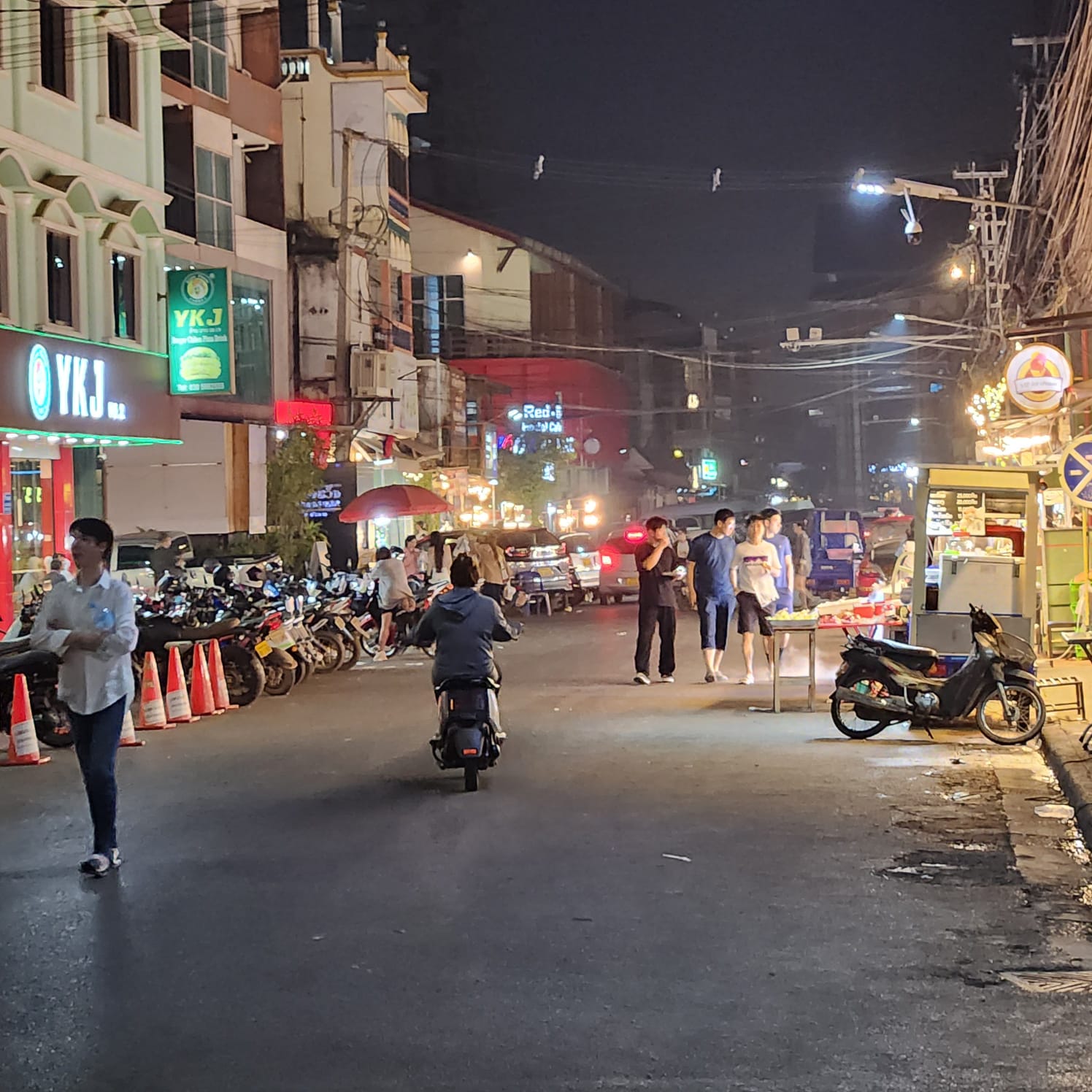
My son traveled to Laos and Japan. He told me he felt safer walking down a dark alley in either place than in most U.S. cities.
Asian culture holds a quiet respect for personal space and flow. In Tokyo, the bars are open all night, each one with its own quirky groove and pulse. Yet, amid the nightlife bustle, an underlying calm remains.
When entering an establishment, it’s polite to say “sumimasen” (すみません), a gentle “excuse me” or “I’m sorry,” acknowledging that you’re entering someone else’s rhythm. A way of saying: I see you. I don’t want to disrupt what you’ve created here. I’ll enter gently. If a person has had too much to drink and ends up on the sidewalk, there’s no judgment. A passerby quietly leaves a bottle of water and moves on.
Travel doesn’t have to be international to shake loose our assumptions. Sometimes a new zip code is enough.
While my son was overseas, my mother was on her own sort of pilgrimage. A Texas native, she headed to Mesquite to visit family she’d never met. Her experience was completely different, but just as revealing. There, politeness means avoiding direct disagreement — especially around politics or religion. But it’s also perfectly normal to be asked how much money you make, whether you own a home, or if you’re set for retirement.
Not to pry — to care. So you don’t feel alone.
What stuck.
Among the suitcases and souvenirs they brought home, it was their stories that stayed with me most.
What it brought back.
Sculptures by the Sea
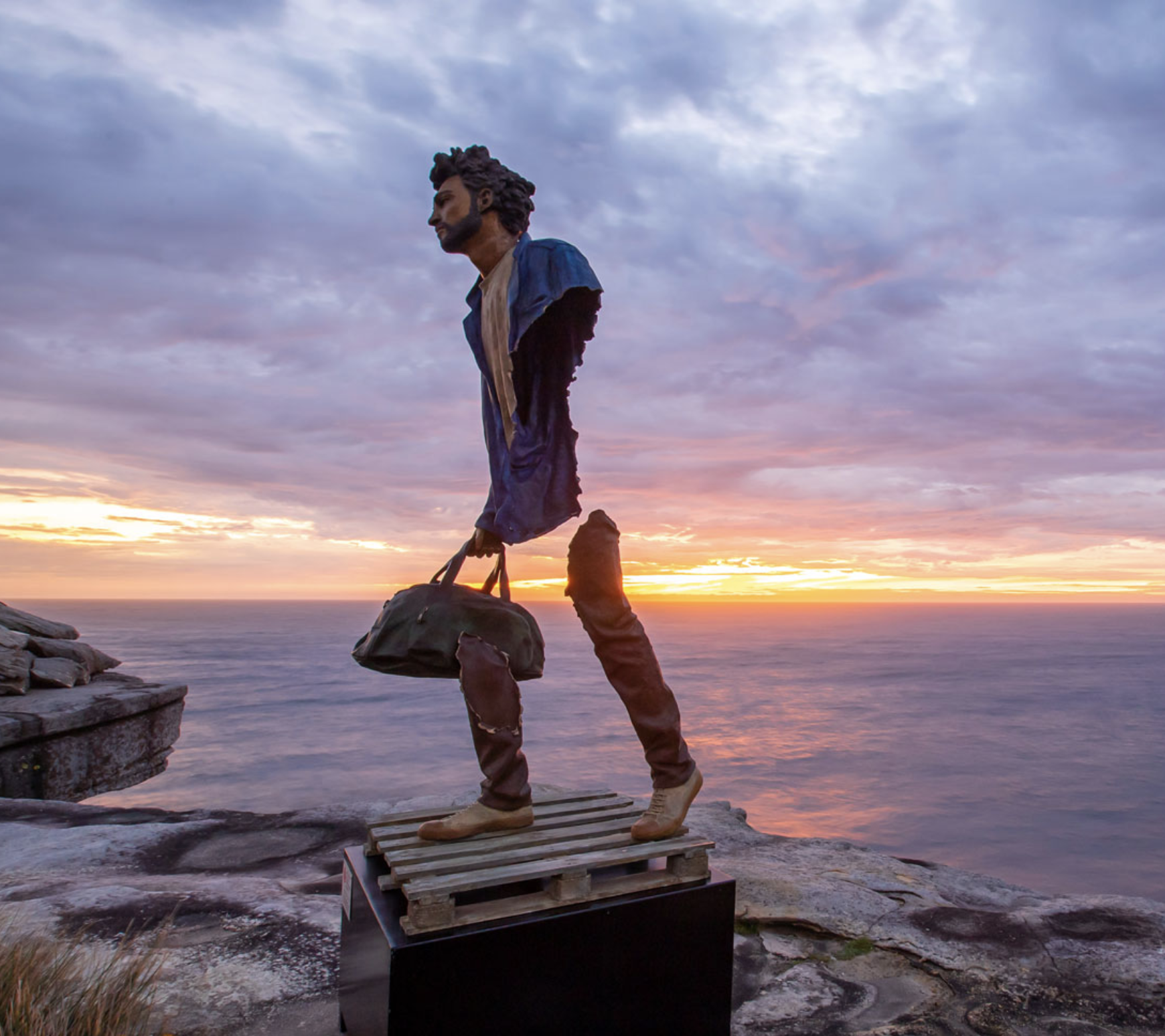
I remembered an article I read years ago. Although the source is long-forgotten, the images remain vivid: bronze sculptures of travelers, missing entire parts of themselves. A man with no chest. A woman without parts of her legs. All going somewhere. Carrying luggage. Artist Bruno Catalano’s work doesn’t only show what’s missing. He makes you feel what’s been left behind, in order to begin again.
Catalano was born in Morocco to a Sicilian family, and grew up in France. This is someone who knows what it is to experience different cultures.
“In 2004, a flaw in one of his characters — a depiction of Cyrano — prompted him to dig and hollow out the chest. A new path of work ensued.”
That’s what travel does. It rearranges you. Those hollowed out spaces fill in with new appreciations.
Customs we didn’t grow up with. Respect that sounds like apology. Concern that looks like bluntness. Safety where we least expected it.
Now you’re moving through the world with eyes that see more than just what’s in front of you. Knowing in your bones there are entire worlds out there, right now, living differently – more gently, more communally, sometimes more justly.
Take a moment to watch this short video of Catalano’s sculptures. You’ll see what I mean. The absence is the message.
Your Turn:
Where have you traveled that shifted your perspective or challenged your assumptions? Whether it was across the globe or just across town, I’d love to hear about it. Scroll down and share your story in the comments below. Let’s go down the rabbit hole together — about travel, culture, memory, and what we leave behind.
“Perhaps travel cannot prevent bigotry, but by demonstrating that all peoples cry, laugh, eat, worry, and die, it can introduce the idea that if we try and understand each other, we may even become friends.” — Maya Angelou
Claim: Undocumented immigrants are getting Social Security numbers and voting!
🔍 Fact check: Nope. False. Absolutely not.
Let’s break it down:
Undocumented immigrants do not qualify for Social Security Numbers (SSNs). The only exceptions are extremely limited — such as those granted work authorization under specific programs like DACA. And even then, it’s not “undocumented” anymore.
You can’t vote in federal elections without proof of citizenship. Voter rolls are managed at the state level and require documentation. Claims of widespread “illegal voting” are not supported by any credible evidence.
Here’s the real kicker: Millions of undocumented workers pay into Social Security using Individual Taxpayer Identification Numbers (ITINs) — but can never claim the benefits.
In 2019 alone, undocumented immigrants contributed $13 billion to the Social Security Trust Fund — without receiving a dime back.
💡 TRUTH:
Undocumented people are contributing to a system that excludes them. They’re not voting, they’re not freeloading — they’re working, paying taxes, and still being scapegoated.
Additional Context
It’s important to note that claims about undocumented immigrants voting in U.S. elections are largely unfounded.Investigations and studies have consistently shown that instances of noncitizen voting are exceedingly rare.For example, a comprehensive audit in Georgia uncovered only a handful of noncitizens who attempted to register, and none successfully voted.
💬 The Good: What’s one positive thing you’ve seen or experienced in prison?
My desire to be a better human being drove me to ask questions and form a unique bond with a couple of staff members who saw something different about me — something of worth… Mr. and Mrs. Jewell treated me with dignity and love in a place where only degrading, negative things existed. I am thankful for those angels to grace my path along the death sentence I existed in.
💬 The Bad: What’s one negative thing you’ve seen or experienced in prison?
The worst thing about prison is the dehumanizing of people. Correctional staff are trained that all inmates are liars, manipulators, the worst people ever — and never to be trusted. There’s no integrity among the majority of staff. The staff member is always right, even when harm is done.
💬 The Change: If you could change one thing about prison, what would it be?
I would change sentence structure and give everyone the opportunity to go before the Parole Board after serving half their time — and after 20 years for life sentences. With support, proof of rehabilitation, and a plan, people should have a chance. I’ve been incarcerated for 29 years and have had 23 years of clear conduct. Some who committed worse crimes or had more infractions have been released while I remain here.
⏩Forward This Email – Someone needs to see this
✍️Take the Quiz – How much do you know about U.S. prisons?
This post is part of our Policy vs. People series, where we break down harmful policies that affect incarcerated people and their families—and spotlight the real-life impact behind the rules.
The Policy: Making phone calls, messaging, and visiting (both in-person and video) expensive, restricted, or outright inaccessible. The Impact: Families are torn apart. Legal help is harder to get. Mental health declines.
It is said that prison is for rehabilitation. But what kind of rehabilitation happens in isolation?
People in jails and prisons are often charged exorbitant prices just to speak with loved ones. Some prisons don’t offer messaging systems at all. Many that do, now rely on third-party scanning services that digitize incoming mail, often blurry, skewed, or incomplete images that strip letters of their intimacy and meaning.
Dayroom phones are limited and long lines mean people are lucky to get even one call that cuts off automatically after 15, 20, or 30 minutes depending on the state. These costs are in addition to what the recipient already pays for their regular phone plan.. For institutions that have video visits, they’re often through glitchy video kiosks. Facilities with video visits often force people to use glitchy, delayed kiosks. And in-person visits? They demand time off work, hotel stays, gas, or airfare and car rental. and navigating strict and inconsistently enforced dress codes. Families are sometimes turned away — even after traveling for hours — based on the whim of an officer, or an unexpected lockdown. Some people haven’t had physical contact with family in years.
This isn’t about safety, it isn’t about rehabilitation. It’s about profit and control. Companies like Securus and GTL rake in hundreds of millions from families who can barely afford to stay connected. Prisons benefit too — by eliminating the “burden” of visits and making money in the process.
Learn More
To dig deeper into the prison telecom industry, check out Week 8 of Worth Rises’ educational series, The Curriculum, titled “Telecom.” This module explores the $1.4 billion prison telecom industry and its devastating impact on incarcerated people and their families.
The irony: We talk about rehabilitation, but we restrict the very lifelines that make it possible.
👊 Let’s change that. If you’ve been impacted by this, tell us.
🗣️ Share Your Story – How has incarceration affected you or someone you love? ⏩Forward This Email – Someone needs to see this ✍️Take the Quiz – How much do you know about U.S. prisons? 💌 Donate Stamps – Help us send more love inside ❤️ Give – Support dignity, connection, and second chances.
Due process is one of the most important rights guaranteed by the U.S. Constitution. It means that the government must follow fair procedures before it can take away a person’s life, liberty, or property.
How due process protects the right to be heard, have fair procedures, and get a fair chance
Both the Fifth and Fourteenth Amendments protect these rights — making sure that no one can be punished, imprisoned, or fined without a chance to be heard, to present a defense, and to be treated fairly under the law.
BONUS: Due process isn’t just for citizens — it applies to everyone under U.S. jurisdiction, including immigrants, incarcerated people, and others who might not always have a strong voice in the system.
At its core, due process is about dignity, fairness, and making sure the rules apply equally — no matter who you are.
➔ Gideon v. Wainwright: is the landmark case about due process and the right to counsel. Why it matters
In 1963, the U.S. Supreme Court ruled in Gideon v. Wainwright that people accused of a crime have the right to an attorney — even if they can’t afford one. The case started with Clarence Earl Gideon, a poor man in Florida who was forced to defend himself at trial. His story reshaped American law and strengthened the idea that due process isn’t just for the wealthy — it’s a right for everyone.
Protecting rights isn’t just about technicalities — it’s about making sure the government earns every step it takes against a person.
As Travis Williams, one of the three public defenders profiled in HBO’s Gideon’s Angels put it: “You wanna take my liberty, you gotta do it right. And if you don’t — acquit.”
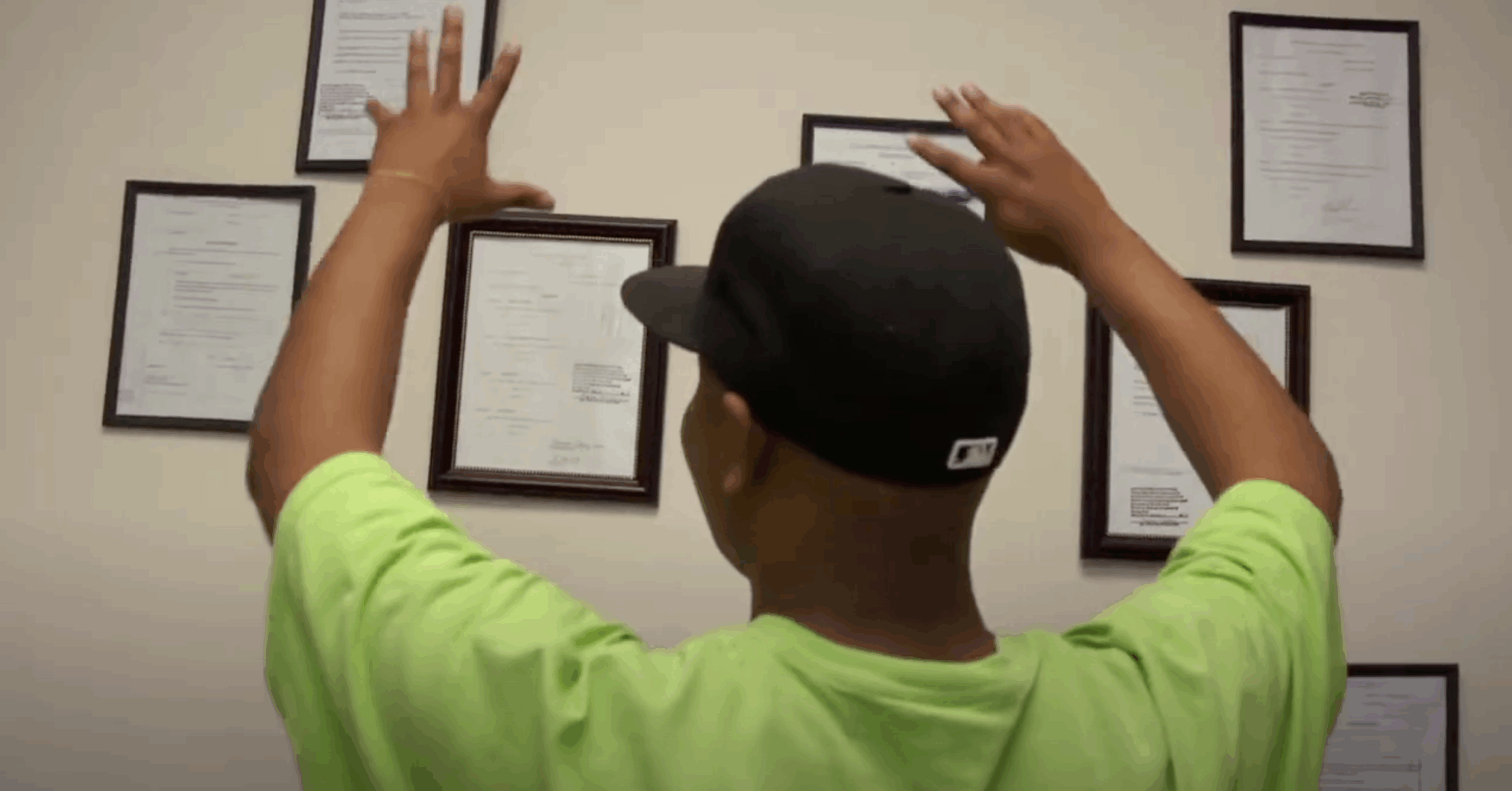
Williams frames his wins and mounts them on a wall. Losses are tattooed on his back. Eight clients’ names so far (in 2013).
This spirit — the demand for fairness — is exactly what due process is meant to guarantee. Watch the trailer for Gideon’s Angels below for a closer look at some of the people fighting for this promise today.
Welcome to Bee Sides short reflections on justice, hope, and the human spirit
This series is a corner of our blog where I gather books, stories, and unexpected moments that linger long after the first glance.
Most will tie back to incarceration, justice, and the quiet fight for dignity. But sometimes? It’ll simply be whatever refuses to let go — the echoes that stay with me. Because that’s what Bee-Sides are for.
Let me know what you’re reading, watching, or wondering about. Maybe it’ll make the next issue.
This one’s about what we carry after unimaginable injustice.
In the span of 24 hours, I saw that unfold in very different ways.
A man I admired, who once wore prison blues, now belittles those still trapped in the system he escaped. I won’t share the specifics of the conversation, only that something in me cracked.
Then came Jeff.
Inside and serving life, he responded without pause when I made an urgent request. I needed help identifying men inside for a developing restorative justice program that Jeff himself isn’t eligible for. The deadline was the following day and I had few candidates.
Credit: Lifegate.com #Kintsugi: The art of precious scars
Within hours, I had names, context, and backstory – everything I needed. If you know, you know: that’s no small feat from behind concrete, metal, and barbed wire.
Jeff’s response didn’t undo the crack. But he unknowingly honored it, turning it into something I could carry.
In Japanese culture, there’s a practice called kintsugi, repairing broken pottery with gold, not to hide the fracture, but to mark it as part of the object’s history. A sign of survival.
That’s what Jeff gave me.
Note: Jeff, the lifer whose kindness sparked this post, is on our waiting list, hoping for someone to connect with. If you feel called to reach out, you can comment below, contact us, or submit an adopter form. (Check out our FAQ about adopting).
🐝 One connection can change everything.
That contrast brought Ray Hinton to mind, a man who lost three decades to injustice, and yet refuses to let it steal his joy. Asked if he was angry (~11:00 in, in the video below), he said:
Scott Pelley: Are you angry?
Ray Hinton: No.
Scott Pelley: How could you not be? Three decades of your life, most all of your life.
Ray Hinton: They took 30 years of my life, as you said. What joy I have I cannot … afford to give that to ’em. And so being angry is … would be giving them … letting them win.
Scott Pelley: You’d still be in prison.
Ray Hinton: Oh absolutely. I am a person that love to laugh. I love to see other people smile. And how can I smile when I’m full of hate. And so the 30 years that they got from me, I count today … I count every day as a joy.
There it is. The difference between survival and true freedom.
What gets carried through the gate?
If you want to hear Ray Hinton’s story in his own words, see the 60-minutes episode featuring Hinton and his longtime advocate, Bryan Stevenson of the Equal Justice Initiative.
You can dive deeper with these powerful books:
The Sun Does Shine by Anthony Ray Hinton Genre: Memoir / Wrongful Conviction Ray Hinton spent 30 years on Alabama’s death row for a crime he didn’t commit. His story isn’t just about injustice, it’s about grace. I still think about his sense of humor, his unshakable belief in hope, and the deep friendships he formed inside. It’s the kind of book that wrecks you and rebuilds you.
Buy on Barnes & Noble (Note: Barnes & Noble is the only vendor allowed to ship into Arizona prisons)
Just Mercy by Bryan Stevenson Genre: Memoir / Criminal Justice Reform Bryan Stevenson’s work through the Equal Justice Initiative has saved countless lives and exposed the brutal realities of mass incarceration, racial injustice, and wrongful conviction.Just Mercy isn’t just a book about the broken system — it’s a call to empathy, action, and courage. Stevenson reminds us that “each of us is more than the worst thing we’ve ever done.” His compassion, perseverance, and relentless belief in human dignity stay with you long after the last page.