Many of our followers are familiar with Eric, who is a frequent contributor to our blog. Read below to learn more about his moving story. The world loves people who help themselves, and now Eric needs some support from the world. Please share his fundraiser, and let’s help him get off to a good start out here.
A few words from Eric
I need your help. Please take a few moments to learn my story, and once you do, I really hope you can find it in your heart to lend a hand. Elements of my story may seem extraordinary, but I assure you that everything you are about to read is completely true and verifiable. Please… read on.
I have been incarcerated for twenty-one years, but I have not wasted my time. I have worked extremely hard, changed my life, earned a PhD in Psychology and Counseling, and dedicated my life to helping others. I have worked as a tutor in the GED program here at the prison for the last fourteen years. I am nearing release, and although I have saved as much as I can, it is not nearly enough to re-launch my life. I desperately need re-entry assistance, and I would greatly appreciate anything you would be willing to give.
Allow me to tell you a little about my journey. In 2001, I took a man’s life in a fight while drunk. I was 21-years-old and addicted to alcohol, marijuana, and methamphetamines in a misguided attempt to self-medicate my internal dysfunction. I was staggeringly self-absorbed, and I take total responsibility for both the actions and lifestyle that put me in prison — I did this to myself. And worse, I hurt so many people. I cannot ever change that, as much as I wish I could. I unquestionably deserved to be sent to prison, but I have worked hard to never be a man who belongs here. I have had plenty of time to reflect upon both who I was and who I want to be.
When I was arrested in 2001, I was angry at the world, confused about who I was, oblivious to the pain and suffering I left in my wake, and profoundly undereducated. I didn’t even have a GED. I was stuck in perpetual adolescence, unable to move beyond an egotistical “teenage” mindset. I didn’t care how I affected the world; I only thought about how the world affected me. I had no conception of how backward that was. Once I took responsibility for the pain I caused as a result of my selfishness and violence, I regained the power to determine the direction of my life, and through a dedication to authentic personal, emotional, and spiritual growth, I have arrived at a place where I genuinely want to use my education and personal experiences to positively impact others.
A transformational moment in my life came while I was serving time in disciplinary segregation for fighting. I believe I had a spiritual experience, yet I never want to push my perspective upon others. Although nothing happened that broke the laws of physics, I believe God illuminated to me the fact that I am worth more than the way I had been living, an idea I had never internalized before, and it permanently altered the focus of my life. I didn’t know how to be anything other than what I had always been, and I certainly didn’t know what the future held. Yet, I knew I would never be the same, but I also knew I had to work hard.
I use the metaphor of a weed often — I look back on my young life, and I see that I was a weed. I was ultimately removed from society because my impact was ugly. I brought nothing of worth to anyone. In fact, I was a burden to those who love me the most, and when I finally realized this, I didn’t want to live anymore. I really didn’t. It was at this low point that some educational opportunities came into my life, and I found purpose.
I went on to earn my GED in 2003, and I was given a job as a tutor in 2008, a job I still hold today. I earned an Associate of Arts degree in 2013 and a Bachelor of Arts in Counseling in 2015, graduating Summa Cum Laude with a 3.98 GPA. I earned a Master of Counseling degree in 2017, and on December 10, 2021 I completed my doctoral program, earning a PhD in Psychology and Counseling. Moreover, I have accumulated over 350 additional CEU credits toward certification in alcohol and drug counseling. I have everything I need for my license except the 4000 hours of supervised clinical counseling, which I cannot accrue until I am released. However, I am immediately employable in my field. Furthermore, my doctoral research revolved around the biological, psychological, social, and spiritual issues and struggles of homosexuality. I am well-trained and ready to pursue a career of service to hurting people with the second half of my life.
My aim is to positively impact those who struggle with substance abuse problems, identity issues, and spiritual direction. I have overcome similar problems in my own life, and I believe my experiences and insight can provide a unique voice that lends credibility to the counseling of struggling people.
I have made so many mistakes in my life and hurt so many people, and although my violence was over twenty years ago, it remains powerfully present for me. It is the motivating factor behind my desire to help others. I don’t want to hurt anyone ever again. I want to be a channel for light in the world by using my faith in God, my education in counseling, and my experiences of failure, incarceration, and personal growth to benefit others. I can never repay all I have taken from this world, but I can spend the rest of my life giving back.
Although my educational achievements are considerable, I think the best lessons I have learned go beyond academics. I have learned what it means to know who I am, to know my purpose, and to find meaning in my mistakes. I have learned that who I am is okay; I don’t need to hide my imperfections behind a mask or to numb my emotional struggles with alcohol or drugs. I have learned self-awareness, empathy, and personal responsibility. I have learned that my life impacts others and that I have a choice about that impact.
Below is video of Eric’s graduation in prison:
I am a featured writer on this website, and you can read my posts here. It will help you see that I am genuine and serious about helping others. I simply need some help to get started — housing, clothing, food, a phone, and transportation all cost money, and while it is not anyone’s responsibility to provide these things, I am asking for some initial assistance. I am extremely grateful for anything you would be willing to give. Thank you so much for taking the time to read my story. Stay safe.
I was given an article recently by Katie Rose Quandt and Alexi Jones titled Research Roundup: Incarceration can cause lasting damage to mental health. The article went in depth about the effects of our current system of penology on the mental health of those affected with mental health issues prior to being incarcerated. But what was most fascinating for me was the evidence that those who previously had no mental health issues were being subjected to such cruel conditions that even those leaving prison are experiencing lasting detrimental affects to their mental health. The affectation is known as “Post Incarceration Syndrome.”
The article took into consideration what I have found to be the most prevalent factor surrounding the mental deterioration in the carceral environment… STAFF. I will always remain fair in my assessments and never place all staff in the same category, but like the inmates, the staff that make the incarcerative experience a pure living hell, as opposed to a corrective endeavor, without a doubt have the most influence, and hence, the biggest impact on the mental health of prisoners.
A recent experience may explain. I am currently housed at a prison in Lake County Florida, appropriately Lake Correctional Institution. At this prison there is no library, no law library, nor any vocational education programs. There is space for a limited number of prisoners to work on obtaining a G.E.D., and a recently-begun wellness education program. There are also some religious volunteers and someone from Toastmaster’s International that comes in once a week to facilitate a group known as the Gavel Club. I am a member of the Gavel Club and the Wellness class. Unfortunately, although the Wellness instructor is very adept at relating her subject matter, almost none of the material is applicable to prison life. We have wellness education in the morning, and a coinciding recreation period in the afternoon. On this particular afternoon after walking several laps around the rec yard I sat my arthritic self on an incline in the grass to rest my knees. The next thing I knew two newer officers, officers, arroyo and stewart, were standing over me ordering me to get up and get moving. I attempted to explain that I had just walked several laps around the rec yard and was resting because I suffer from arthritis. None of the precipitating factors made any difference to these two officers. I know this because they said so when they replied, “I don’t care, get up and get moving like I told you.” I then tried to explain that the Wellness instructor is aware of my situation but was again informed that that held no weight with these two power hungry officers, that they had given me an order. When I asked if they would treat their grandfather this way that was all the reason they needed to whip out the handcuffs and begin the walk of shame across the rec yard with their quota of radical senior citizens in tow on the road to confinement where I would begin days if not weeks…yes you guessed it, doing nothing but lying on my back. The worst part for me would not be the loss of what little stimuli we do have by being placed into confinement, it was being essentially arrested by these two officers simply because of the power play that was created by them in the first place. When we reached the captain for approval to “lock me up,” thankfully he was somewhat level-headed and had the presence of mind to inform the officers that “the thing that started the whole thing,” my laying in the grass during recreation, I was actually allowed to do. The captain left it up to the officers whether or not to place me in confinement and I have no idea why they declined but by that time the damage to my psyche had already been done. While removing the hand cuffs the other officer had to get in one last jab by making the statement, “and wipe that smirk off your face.”
Now mind you, I’m sixty years old being ordered around by two recent high school graduate misandrists because FDC has lowered the recruitment age to 18. What can possibly be accomplished by placing an 18 year old in a position of authority over a sixty year old? The only thing to be accomplished is having a body to fill the position. There is absolutely zero rehabilitation even if that were the goal. Which it is not. The end result was that I was ordered to leave the rec yard and return to the dormitory. So instead of hitting what they were shooting at, me to be physically active on the rec yard, I went to the dorm and proceeded to lay back on my bunk doing nothing. Not only was my physical well being completely disregarded by officers arroyo and stewart, but it was literally days before my mental functioning began to process the event without anger, depression, and the feeling of degradation. And to be quite honest I still have not gotten completely over it because I find myself doing everything possible to avoid these two officers even in passing. The real question is will I ever be able to deal with life on life’s own terms again whether inside or outside these fences?
It is not surprising the recidivism rate is as high as it is as mental illness appears to be the touchstone of the largest incarceral system the world has ever known.
By the way, did I mention Lake C.I. is a designated mental health facility. A lot of good that does.
On January 23rd I took a Covid PCR test and, because of the absolute mismanagement of the Covid response in our prison, I tested “Covid Punitive.” I had been going to work, taking rapid tests to get in, for almost 2 weeks without incident (including the time of the PCR) and yesterday, my results were in… I was positive. I can remember a day last week of some sweats and a sore throat, but we had just had flu shots, so I assumed it was associated with that. So, in the prison’s terrible response to this, I was snatched from work, locked in my cell, told to pack everything I own in 15 minutes, chained and shackled, loaded up on a bus with 78 other positives, and taken to another prison without a clue what was happening to us.
There, I sat in a filthy cell where I could touch two walls at once, without anything to clean it with. It has open bars and all night I could hear others struggling to breathe, coughing and hacking. The “mattresses” we use are a pad about two inches thick on a hard metal tray bolted to the wall and it makes your arms numb in the night. We were told we will only have one chance to get out for a shower or a phone call — once a day. This prison is over 100 years old and this cellblock had been recently shut down. It’s disgusting. But it’s now the “Covid Isolation” unit. I’ve been stripped of everything — all the meager comforts I had — because it’s all now in storage (I hope) and get to deal with this 10-14 day knee in the back (or longer if people keep testing positive). Imagine if you had tested positive and had to pack up your home, hoped someone stored all of it, got harnessed like an animal and moved to some random, filthy house, halfway across town… and, like some here, do it all while you can hardly breathe.
There’s a logical, scientific, and humane way for this prison command to deal with sick people, but instead of seeing an opportunity for compassion, it’s a chance at kicking someone while they’re down. Everyone around here is terrified of the Covid tests. Not because of being ill, we can deal with that, but a Covid positive test result is really a Covid Punitive test result. If you think Covid can make you feel miserable, you ain’t seen nothin’ yet…
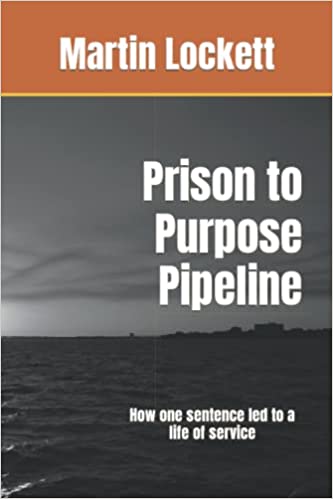
Many of you are familiar with Martin Lockett, who has written many blog posts for us over the years. Today, Martin Luther King, Jr. Day 2022, is the perfect day to let you know that since his release in June of 2021, Martin has republished his book – formerly Palpable Irony (see Rick’s review here), with a new title: Prison to Purpose Pipeline: How one sentence led to a life of service.
On this day, we encourage you to be engaged in efforts to protect voting rights. Write and call your elected officials. March, rally, organize, mobilize. Take actions that help bend the arc and bring forth the kind of world MLK Jr. dreamed about — but did not live to see.
“Make a career of humanity. Commit yourself to the noble struggle for equal rights. You will make a better person of yourself, a greater nation of your country, and a finer world to live in.” Martin Luther King, Jr.
This is also a good time to watch Martin’s MLK, Jr. speech, recorded while he was still incarcerated.
Is it possible to quantify the amount of, or in the case of amerika’s prison industrial complex, the lack of positivity? Even in the comparative state, measured against the vast amount of hypocrisy, the lack of positivity equates to nothing less than a vacuous state of existence for the millions of men and women held in this country’s prisons and jails.
One example is when we were having conflict with a sergeant at another prison who thought it fell under his job description to shave all the prisoner’s heads on their way back from chow. While discussing the issue with the colonel, I asked if his hair cut was in compliance with what he was saying to me about what the rule states. His answer was a resounding no that he was not in compliance with their own rules. The statement was made without malice. It was to be taken as a matter of fact and not to be challenged. There is no discussion about issues. If you attempt to resolve a problem you’ll likely be punished rather than encouraged.
Of course there is no room for debate when it comes to the ambiguous nature of the language of the rules but looking at the realities of everyday prison life you can’t help but understand why the prisons and jails are full and expanding.
There is a massive drug problem in amerika’s prisons. How can that be, one might ask. Well there may be some coming in through visitors. Some. It’s a given that the prisoners are not taking furloughs out to drugs ‘r’ us. That leaves the source to be pondered. But not very long I bet. In the visitation park there is a poster with six or eight photos of presumably former corrections officers and their criminal exploits which include introduction of contraband, sexual misconduct, etc. At this prison alone there have been murders of prisoners by officers, gang batteries by officers that were surreptitiously recorded and went viral on the internet, falsification of documents to cover up these actions, and myriad other felonious acts, many that go undetected everyday. But let’s have a look at those messages that are conveyed on a much smaller scale.
For instance, smoking has been taken from prisoners as a general rule. There have been fiscal reasons cited for this prohibition – health care costs associated with smoking and so forth. Also the butts lying around, and other trash associated with smoking. But the rules put in place for officers are somewhat more obscured. It began that officers were not allowed to smoke while on the compound. They had to wait until it was their break time and walk outside the gates to smoke. Then, some prisons designated smoking areas inside the fences but away from prisoners. Now it appears there are no restrictions at all and officers are smoking within arms reach of prisoners while they are talking to them. What kind of health care savings could there be in propagating smoking cessation classes for the thirty thousand or so employees of FDC? But that’s just scratching the surface of hypocrisy.
Prisoners are not permitted to carry any food out of the chow hall. But most meals we are given less than five minutes to eat. I cannot remember the last time I was able to finish a meal. Such as they are. But one thing I do know is there are no provisions giving officers free reign of the kitchen for inmates to cook for them. I don’t know that there are overt promises made but you can bet there is some type of quid pro quo. This is commonplace in every prison I’ve been housed at. There is no doubt that when officers trade with prisoners they are breaking rules and laws but when officers trade chow hall food to prisoners that they have brought from the kitchen for favors or other products, there are messages that prisoners get, that lead them to believe something is only wrong if you don’t get caught. Or worse yet, if someone with some sort of authority lets you get away with something its OK. Did I forget to mention that we are permitted to keep food in our lockers that was purchased from commissary? Senselessness. For instance, we are able to purchase peanut butter from the canteen but we have no way to get bread for a sandwich. In the privately owned and operated prisons you can purchase these items, but not in the state facilities. So you cannot take bread or any other food from the dining hall. If you get caught, technically you can receive a citation of sorts but mainly you are made to throw it away. Imagine, throwing away food just so a person can’t eat it. I’ve asked a couple of officers about this and they are always speechless.
I have to wonder, will we ever get to the point where we will want our citizens to become better human beings after we ‘correct’ them? Will we ever provide an environment where that’s possible? We had better get on it because it’s going to take a very long wide turn to make the changes we need.
In a state like Washington that has no functional rehabilitative motivators, House Bill 1344, Emerging Adult Parole, may be a step in a positive direction. Washington’s parole is limited in scope to juvenile offenders and sex offenses, with very few parole cases tied to a failed system from the 1970s and 80s that allowed hundreds to be simply warehoused in prison. With the movement of HB1344 in our legislative session starting January 10, 2022, many more youthful offenders can be moved to a parole system that will provide both a reduction of prison populations AND be a qualifier for meaningful rehabilitation. As brain science has expanded over the last several decades, cases before the US Supreme Court (the elimination of life sentences for juveniles), down to the Washington State Supreme Court (Personal Restraint Petition of Monschke, establishing 21 as the age of majority for culpability of crime in cases where “Life Without Parole” sentencing was given), have all agreed that those below a certain age, notably those between 18 to 21, are more impulsive and less matured and have a higher propensity for committing crimes, and should be handled differently than fully matured brains.
But those inmates grow up paying for those impulses, sometimes in the shadow of decades long exceptional sentencing, where a minute of youthful indiscretion leads to decades, or a lifetime, of imprisonment. HB1344 would move those under this youthful category to a parole system already in place for juveniles. A person at age 40 is distinctly different than at age 19, but the current design of our state’s system provides no recognition of that fact. But what if a thirty-or-forty-something grasps the true reality and gravity of their crime with maturation? For a country that demands a legal age for controlled substance usage, we seem to see the responsibility goalpost travel when it comes to crime. The brain science shows responsibility patterns are the same between an 18 year old, a 21 year old, and even for 15 and 16 year olds. Shouldn’t this also be accounted for equally in all aspects of legal findings?
HB1344 will require a younger offender to serve a statutory minimum portion of the sentence, but provide incentive room for that offender to capitalize on his maturity through positive rehabilitation. If a younger person can show significant change and qualify it to a parole board, he may be granted an opportunity at relief from the incarcerated portion of a sentence. And for a state like Washington that doesn’t do this for all categories of offender, it’s high time we start demanding the correctional system be held accountable for ensuring a quality product is being placed back into the community. Efforts like HB1344 would provide such accountability, while being backed by courts throughout the nation and tangible scientific findings.
As it stands, I know many people that entered this system as youngsters and will leave just in time to collect a social security pension they never paid into, and without a support system that was lost a lifetime ago. Is that the right answer? I suggest it isn’t. And as for victims of these offenders, remorse comes with a much heavier hand when one is old enough to understand the power of that remorse and the room to be responsible with it. Allow time to add that remorse to the benefit of your community and parole to ensure it contributes vibrantly post incarceration. Additionally, values and morality can be fostered through hard work and hope. For a system that currently replaces a young adult’s family structures with bureaucracy, it takes personal determination to learn them. HB1344 is the hope and a parole board will make sure the hard work is present.
Expanding parole is a meaningful step to fixing an expensive and failing system. Please show your support for this bill.
The prison system has always had its flaws, and its also had its fair share of celebrities. No, we’re not talking about the doom and gloom of high profile cases, we’re talking about literary legends; the kind of convict we all want to meet.
But this post isn’t just about who did time (with or without a crime), it’s about reading between the lines of why these geniuses were actually arrested. Spoiler alert, there was no justice about the justice system.
And who first? It’s over to the classics. None other than Oscar Wilde.
Many know Wilde for being the author of (my favorite book) Dorian Gray. He was flamboyant and fabulous is ways that would be celebrated today. Despite literal brilliance, he was severely cautioned by publishers to tame down the naughty narrative he was portraying. Shockingly, the books we see in print (which gives 50 Shades a run for its money) are the edited and softened versions. One thing he refused to stay quiet about though was his homosexuality which landed him 18 months in prison. Thankfully, we don’t arrest people for their sexuality now, but there are still cases where a private sex life is used to taint a jury, and we think that’s downright disgusting. Things aren’t always kept to the case details, especially if you’re one of 36 in 100 Americans who are into the BDSM scene*.
Next up is a political prisoner from not that long ago — Aleksandr Solzhenitsyn.
Russian novelist and historian Aleksandr Solzhenitsyn wad arrested for speaking out against Stalin, but his excruciating stint wasn’t just in a jail. He actually spent 7 full years in a labor camp. In 1970 he was awarded the Nobel Prize in Literature but nothing can account for lost time.
He wasn’t the only prisoner of politics though, Daniel Defoe, the author of Robinson Crusoe, was arrested for sharing unfavorable opinions on government regimes too. Rumor has it that he was a real man of the people though and that instead of being pelted with rotten fruit as was customary at the time, they tossed flowers to him in the stocks.
But sexuality and politics aren’t the only things to get a person in trouble in the history books. Playwright Christopher Marlowe was imprisoned for the crime of being an atheist! Some argue that when you read between the lines, religion can get you into trouble with the law more than other things. Keep an eye on the news and ask yourself if there’s an unfair representation there. You might be shocked when you look at the statistics.
So far we’ve looked at criminals who wouldn’t have been considered such today, but there’s room for a quick bit of trivia from some who arguably deserved their stint in prison.
So, what do Chester Himes, Joan Henry and Frank Elli have in common? They’re all writers who used their experience to write award winning novels. That might not say anything about the innocent but it does show that the guilty can become worthy members of society after time behind bars. Everyone has a fresh chapter worth writing.
In her remarkable book, My Stroke Of Insight by neuroscientist Jill Bolte Taylor, PhD, I was taken on her profoundly objective tour of her own life trauma. As a neuroanatomist who taught and performed research at Harvard Medical School, when Taylor had an abrupt eruption of blood vessels in her brain, she witnessed her own brain deteriorate as she struggled through her stroke. This book is a journey of that event, and the eight years after, that brought her from an unsuspecting brain scientist with a congenital defect waiting to challenger her, to a stroke survivor who was able to document everything with a curious mind, and spread a brilliant message. She explains so much in factual science, what her conditions were, and how to recover, all while challenging the reader to objectively explore the subjective elements of living a wonderful life.
The power of her mother’s love is also a noted part of this book. G.G. as she’s known, pushes her daughter Jill through recovery and is always present to support both the successes and failures as caregivers often do. G.G. had to teach her things like reading and math again and a team of medical professionals helped her regain her life’s functionality. There’s a chapter where Taylor describes a list of things she needed most in her recovery and I found this to be an amazing chapter. The things she describes are the same things people need most to live a resilient and fulfilling life, and she showcases these needs in a straightforward way. She combines her personal philosophies and factual findings together to give the reader an outcome needed by all of us – hope and a roadmap to happiness.
This is an extremely well-crafted book, and Jill Bolte Taylor heroically embraces life on her terms and in the best of ways. There’s a lot to learn from this – about brain science, the human condition, recovery tactics – and is a wonderful package of determination to rise from the unthinkable. To read the impact and recovery of her stroke through the eyes of a brain scientist is truly a read worth remembering.
See here for Bolte Taylor’s TedTalk: “Jill Bolte Taylor got a research opportunity few brain scientists would wish for: She had a massive stroke, and watched as her brain functions — motion, speech, self-awareness — shut down one by one. An astonishing story.”
I have been incarcerated for over twenty years now, a lifetime for many. When I was 21-years-old, I took a man’s life in a fight that I started. Yet, while I unquestionably deserve to be in prison, I never wanted to be a man who belongs here, and I have worked hard to never be. It took some time for the momentum of positive energy and self-discipline to become transformative, but I have not wasted my days. On December 10, 2021 I graduated with a PhD in Psychology and Counseling, but my journey goes beyond academics.
I arrived at Eastern Oregon Correctional Institution an emotionally underdeveloped 21-year-old with little education. I didn’t even have a GED, and I was profoundly self-centered and insecure. For years I used alcohol, drugs, and lies to cover my shame and conceal my psychosocial dysfunction, but when I arrived here and the heavy metal door shut behind me… and on my life, I was left with nothing but the truth of who I was and what I’d done. I grieved over the loss of my life–as any narcissist would, but deep down, I knew I had hurt so many people, one of whom would never go home. I grieved for him, too, and I knew I must do something different. I could not stay who I was.
Not much real change happened in the first couple years of my incarceration. The system is structured far more around order and security than rehabilitation, and I didn’t know how to change myself or be anything other than what I had always been. Consequently, it took time for me to learn how to be different, and it wasn’t easy.
A transformational moment in my life came while I was in disciplinary segregation after a fight. I had what I believe to be a spiritual experience, which I describe in an earlier blog post on this platform, and it redirected the focus of my life–at that point, although I did not yet know what my future held, I knew there was something more for me. My life was not forfeit. I knew there was a purpose for me that I had to pursue.
I prayed often after I was released back into general population. Nothing too pious or formal, but a sort of running commentary with God. I never heard an audible response, but whenever I would pray about direction or ask for guidance, I always felt a one-word response in my spirit: Learn. That is all I was given. So… I pursued it with all of me, leading to significant educational achievement.
I earned my GED in 2003, and in early 2008 I was hired as a tutor in the Education Department, a job I still hold today. Through a career development site available in the computer lab, I found a university that offered distance learning for the incarcerated, and I contacted them.
My mother had recently received some money, and she asked me if I needed anything. I could have asked for trivial, comfort-oriented things, but I told her about the educational opportunity I had found, and she was on board. She paid for my entire education, from the first course in my associate degree program to the final practicum for my doctoral program. I will never be able to adequately express my gratitude, for she very likely saved my life.
I use the metaphor of a weed often — I look back on my young life, and I see that I was a weed. I negatively affected all the good around me, and I was ultimately removed because my impact on those around me was universally ugly. I brought nothing of worth to anyone, and when I realized this, I simply had no desire to live because I knew I was a burden to everyone, especially those who love me. I just didn’t want to keep going if I could not be any better than I was. It was during this low period that these educational opportunities came into my life.
The rest is really history from an academic standpoint. I earned an Associate of Arts degree in 2013, a Bachelor of Arts in Counseling in 2015, graduating Summa Cum Laude with a 3.98 GPA. I finished my Master’s of Counseling degree program in 2017, and I finally finished my educational journey in 2021, completing my PhD program. Moreover, I have accumulated over 350 additional CEU credits toward earning my certification in alcohol and drug counseling. I have everything I need for my license except the 4000 hours of clinical counseling, which I cannot get in here. I am immediately employable in my field, however.
The best lessons I have learned go beyond academic achievement. I have learned what it means to know who I am, to know my purpose, and to find meaning in the pain of my own mistakes. I have learned that I don’t need to wear a mask to hide my flaws or to use drugs and alcohol to numb my emotional struggles. I have learned self-awareness, empathy for others, and acceptance of my weaknesses. I don’t need to force others to view me the way I want them to, and I don’t need to judge others in order to feel better about being me. In my journey from GED to PhD, I have learned how to be authentically me, and there is no greater gift that God could give me.
I have made so many mistakes in my life and hurt so many people, and although my violence was over 20 years ago, it remains powerfully salient for me — it is a motivating factor in my life. I don’t want to hurt anyone ever again or give space to or be a channel for darkness in the world. I want to be conduit for light and contribute significantly to the good in the world by using my faith in God, my education in counseling and psychology, and my experiences of failure, incarceration, and personal development to benefit others, especially those wrestling with issues of identity and addiction to harmful substances or behaviors.
I look forward to the next step in my journey of becoming all I was designed to be, and I am so grateful to everyone who has helped me along the way, my friends and family, my mother, and the Blue Mountain Community College instructors for whom I work have been life-changing influences in my life. I simply could not be where I am today without all of them — I am endlessly grateful. I have said it before: although I ended up in prison as a result of my own self-centeredness, prison is not the end of my story.
In her follow up volume to “84, Charing Cross Road“, Hanff takes you on a ride through her adventures in London in “The Duchess of Bloomsbury Street.” After 20 years of corresponding with the Doel family and a burning desire to visit London, Hanff finally cashes in on her worldwide popularity with the publication of “84” and, at age 55 in 1971, decides to walk the streets of a city that was the source of her fantasies… and success.
Following some similar formats in the way of letters, Hanff captures her trip in a journal encased in amazingly detailed descriptions of London’s citywide layout. Personally, as I read this, I wish I had an atlas or Google Maps to virtually share her travels. Helene Hanff has a very distinct personality of an American from New York and her neurotic behavior is cleverly comical as she attends book tour commitments throughout London. With new characters like the Colonel (someone who might be described as a groupie, or a stalker) and the management team of her London based publisher Andre Deutsch who wrangle her through her tour, you also get to meet, as Hanff did, Nora and Sheila Doel… the family of Frank Doel, who was the other half of Helene’s charming 20-year-long letter communications to London’s Marks and Co. Booksellers in “84”.
This follow up has much of the same charm and character as its predecessor and, as before, it showcases a wonderful older generation of class and style with it. Hanff’s encounters with the British lifestyle she’s always envisioned are endearing and highlights what expectations do to someone who takes on her dreams in midlife. A fun and heartwarming ride with Helene through London in the 70s will make you often laugh. While it could be read on its own, I highly encourage reading “84, Charing Cross Road” to truly appreciate all that went into the need for this follow up book. If you like the storytelling of folks like Nora Ephron, you’ll love Helene Hanff.






 This is an extremely well-crafted book, and Jill Bolte Taylor heroically embraces life on her terms and in the best of ways. There’s a lot to learn from this – about brain science, the human condition, recovery tactics – and is a wonderful package of determination to rise from the unthinkable. To read the impact and recovery of her stroke through the eyes of a brain scientist is truly a read worth remembering.